Three areas. Different kinds of clues.
The publisher’s overview describes three measures that can be used separately or in combination. The questions focus on reasoning while reducing demands on language and advanced academic knowledge.
Verbal
Find a concept shared by five of six pictures and identify the exception.
Nonverbal
Work out relationships among figures, including patterns, positions and orientations.
Quantitative
Reason with quantities, numbers and shapes to complete a relationship.
Timing for Grades 5 and 6: the MHS administration table gives a maximum of 35 minutes for 40 questions in each assigned test. Setup, directions and the practice questions are separate. If all three are assigned, the maximum question time totals 105 minutes; the school determines the session schedule and any applicable accommodations.
The authors’ FAQ describes grade-specific test forms. The same broad reasoning areas can appear at different grades without the official forms being identical.
What changes in fifth or sixth grade?
For fifth-grade families
District arrangements differ. Carrollton–Farmers Branch ISD’s NGAT page includes fifth-grade screening across the three areas. Beaverton’s current plan assigns Quantitative in Grade 5, following Nonverbal in Grade 3 and Verbal in Grade 4. Those are different practice needs.
For sixth-grade families
Asheville City Schools’ family FAQ identifies Nonverbal testing in Grade 6. This is one district’s approach, not a national sixth-grade requirement. Ask your school whether your child will take a particular area or a broader set.
Use the district tracker for source links, the FCPS guide for Fairfax County context, and the score guide when the report arrives. Local screening and placement decisions need more context than a workbook result.
Six questions. Explain the rule.
These are excerpts from the NGAT Grades 5–6 Practice Workbook. The original Form A question numbers are retained. The PDF adds six more questions and a separate answer key.
For verbal questions, choose the picture that does not belong. For the other areas, complete the pattern or follow the printed direction. Look at every choice before opening the answer.
A shared feature
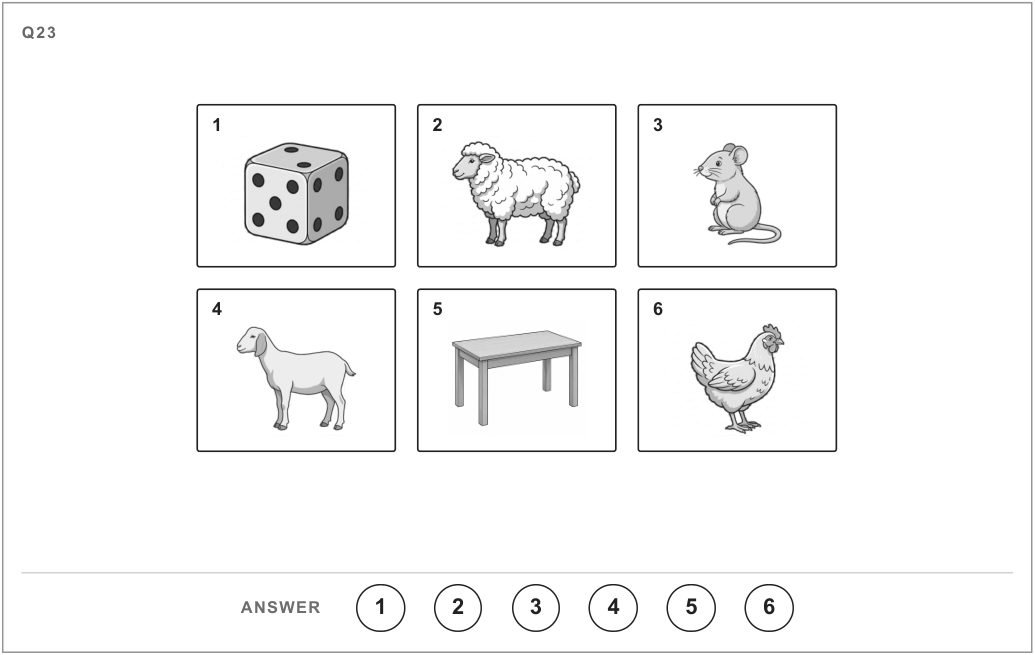
See the answer and rule
Answer 1. The sheep, table, chicken, mouse and goat have legs. The die has none.
Check all five members: animals have legs, and so does the table. A rule of “living things” would leave both the table and the die outside the group, so it would not group five pictures.
What the objects can do
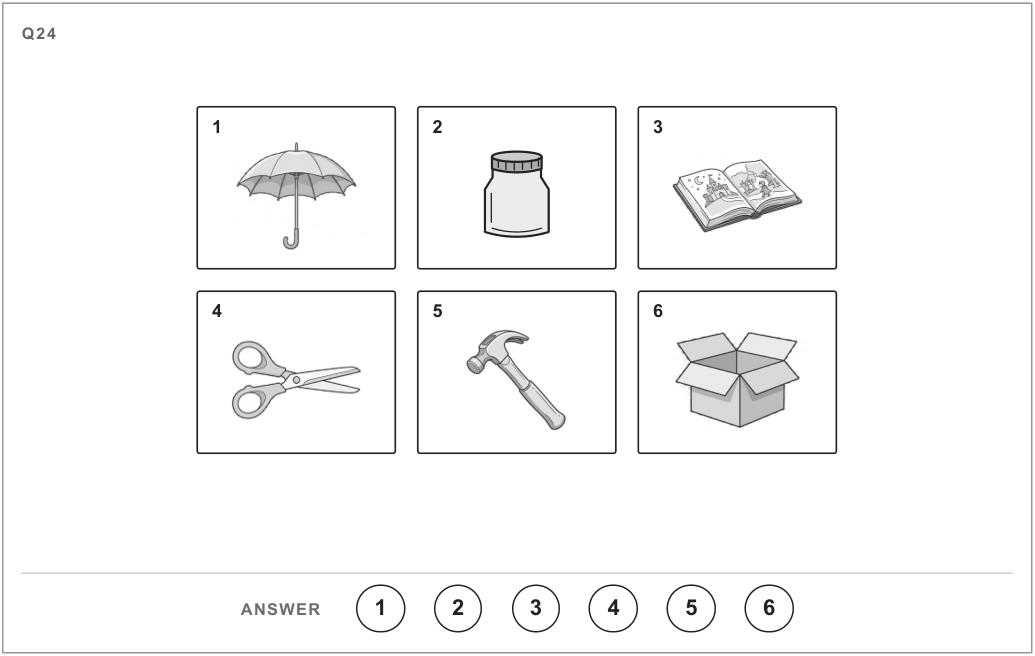
See the answer and rule
Answer 5. Five things can open. The hammer cannot.
An umbrella, jar, book, pair of scissors and box can each open and close. The pictures do not need to look alike to share an action.
Shape and shading
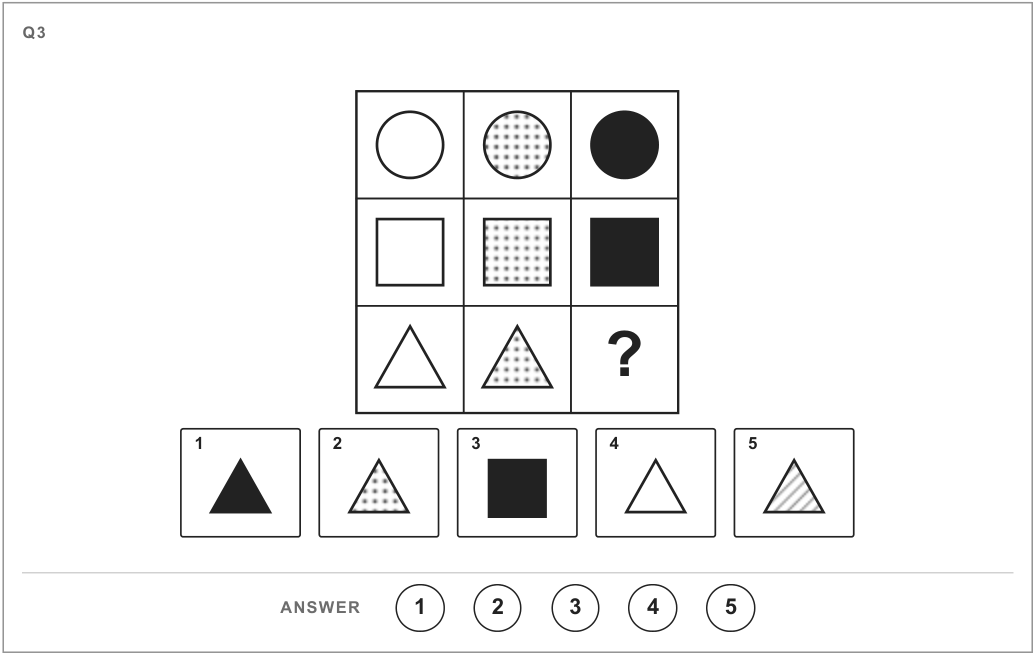
See the answer and rule
Answer 1. The bottom row is triangles and the last column is solid, so the missing cell is a solid triangle.
Use both directions: the row gives the shape and the column gives the shading. A solid square follows only the shading rule; an outline triangle follows only the shape rule.
Track three features
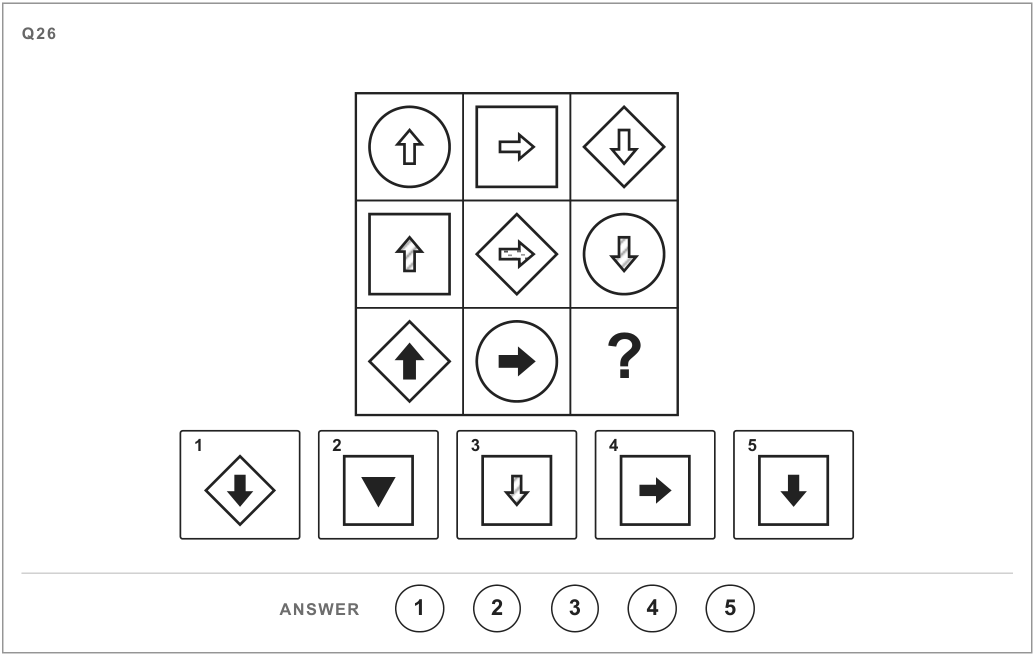
See the answer and rule
Answer 5. The missing outer shape is square; its inner arrow uses the right column's 180-degree turn and the bottom row's solid fill.
There are three things to track. Each row and column uses the three outer shapes once. Arrows point up, right and down across every row. The bottom row uses solid arrows. All three checks select the square with a solid downward arrow.
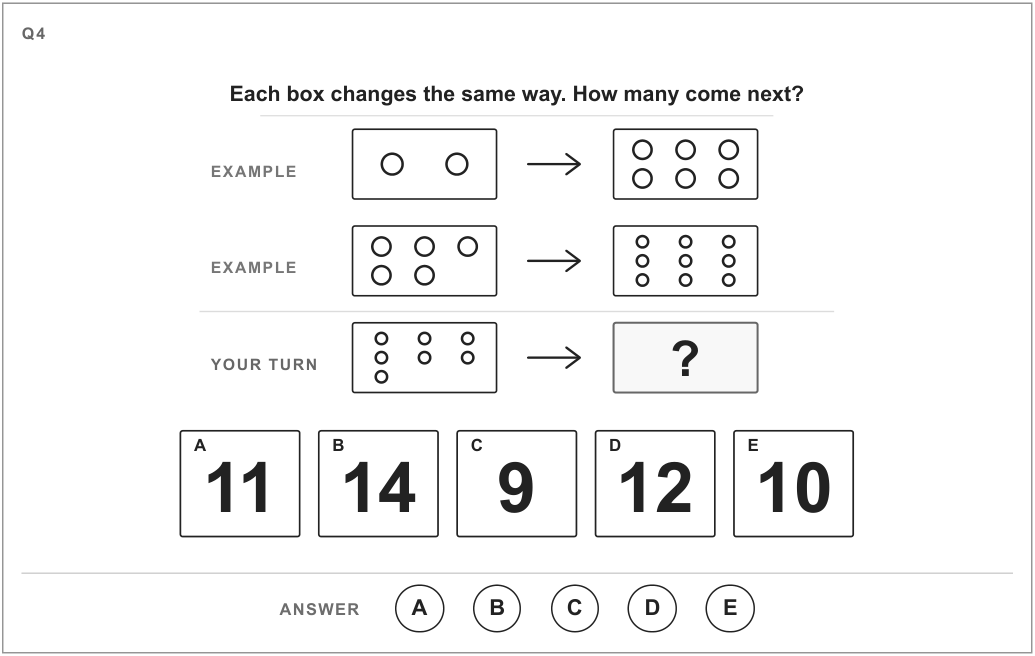
Find the same change
See the answer and rule
Answer A. Two becomes six and five becomes nine by adding four, so seven becomes eleven.
Adding four explains both examples: 2 + 4 = 6 and 5 + 4 = 9. Doubling does not explain either pair. Apply the same addition to 7 to get 11.
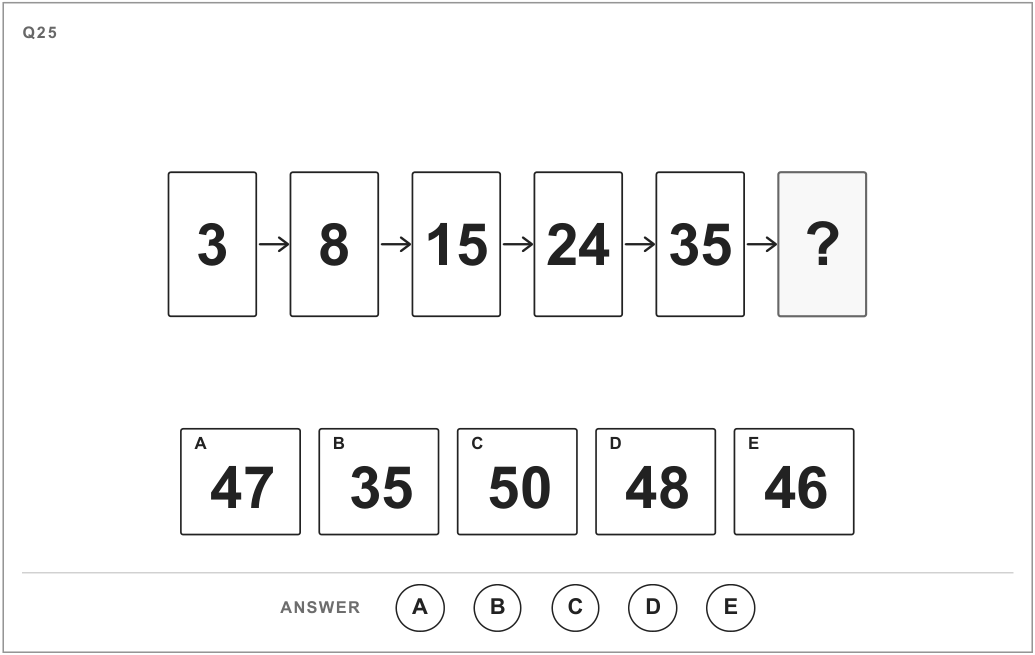
A changing step size
See the answer and rule
Answer D. The increase grows by two each time. Adding thirteen to 35 gives 48.
Write the gaps: +5, +7, +9, +11. The next gap is +13, so 35 + 13 = 48. Repeating the most recent gap would ignore how the earlier gaps change.
Keep the complete sample.
Twelve questions · 9 pages · 5.1 MB · Explained answers
A useful way to approach optional practice.
The test authors say formal studying is unnecessary. Their parent guidance emphasizes careful attention to directions, considering the choices and arriving rested. Follow your school’s advice about preparation.
If your child enjoys trying a few original puzzles, make the explanation the point of the activity:
- Attempt a small set. Leave the answers covered and give your child time to think.
- Name the rule. Ask which features matter and whether the rule explains every completed example or every member of the group.
- Compare the explanation. If a choice seemed plausible, check which part of the rule it misses. Then stop or return another day.
In the workbook, the skill ladders provide an entry point before the two practice forms. Both Form A and Form B are for the Grades 5–6 band. A sample score does not translate into an official percentile or a gifted-program decision.
Questions from fifth- and sixth-grade families
Is the fifth-grade NGAT the same test as the sixth-grade NGAT?
The official tests have grade-specific forms. Reasonwell’s Grades 5–6 workbook is a shared practice resource for that grade band; its Form A and Form B are two practice forms, not the official Grade 5 and Grade 6 test forms.
Does every fifth or sixth grader take all three tests?
No. Districts choose who is screened and which test areas are administered. Read the school notice or ask the testing coordinator to confirm the plan for your child.
Why are the verbal questions pictures?
The verbal task asks students to identify a shared concept among pictures. In these original practice examples, five objects fit one rule and the remaining object does not. It is different from a spelling or reading-comprehension worksheet.
Can these sample answers tell me my child’s percentile?
No. This is a small set of original practice questions, not a standardized or normed assessment. An official percentile depends on the actual test and the comparison group used in reporting.
Is NGAT the same as NNAT?
No. Check the full test name on the school notice. This page covers the Naglieri General Ability Tests, published by MHS. If the notice names NNAT, use the test comparison linked below.
Where can I find the answers and a printable version?
Open “See the answer and rule” below each example. The free nine-page PDF contains twelve questions, including the six shown here, with the answer key on sample pages 8–9.
Sources and scope
Publisher and district pages checked September 7, 2026. School plans can change; the school’s current notice is the source for your child’s arrangements. All six illustrated questions are original Reasonwell workbook excerpts.
- MHS: Naglieri General Ability Tests overview
- MHS Help Center: administration and grade-specific time limits
- Test authors: frequently asked questions
- Test authors: parent preparation guidance
- Carrollton–Farmers Branch ISD: NGAT screening
- Beaverton School District: Talented and Gifted
- Asheville City Schools: family FAQ
Naglieri General Ability Tests™ (NGAT) is a trademark of Multi-Health Systems Inc. (MHS), used for identification. Reasonwell Press is independent and is not affiliated with or endorsed by MHS or the test authors. These original practice questions are not actual test items and do not predict scores or guarantee placement.