Question 1
Show answer and explanation for question 1
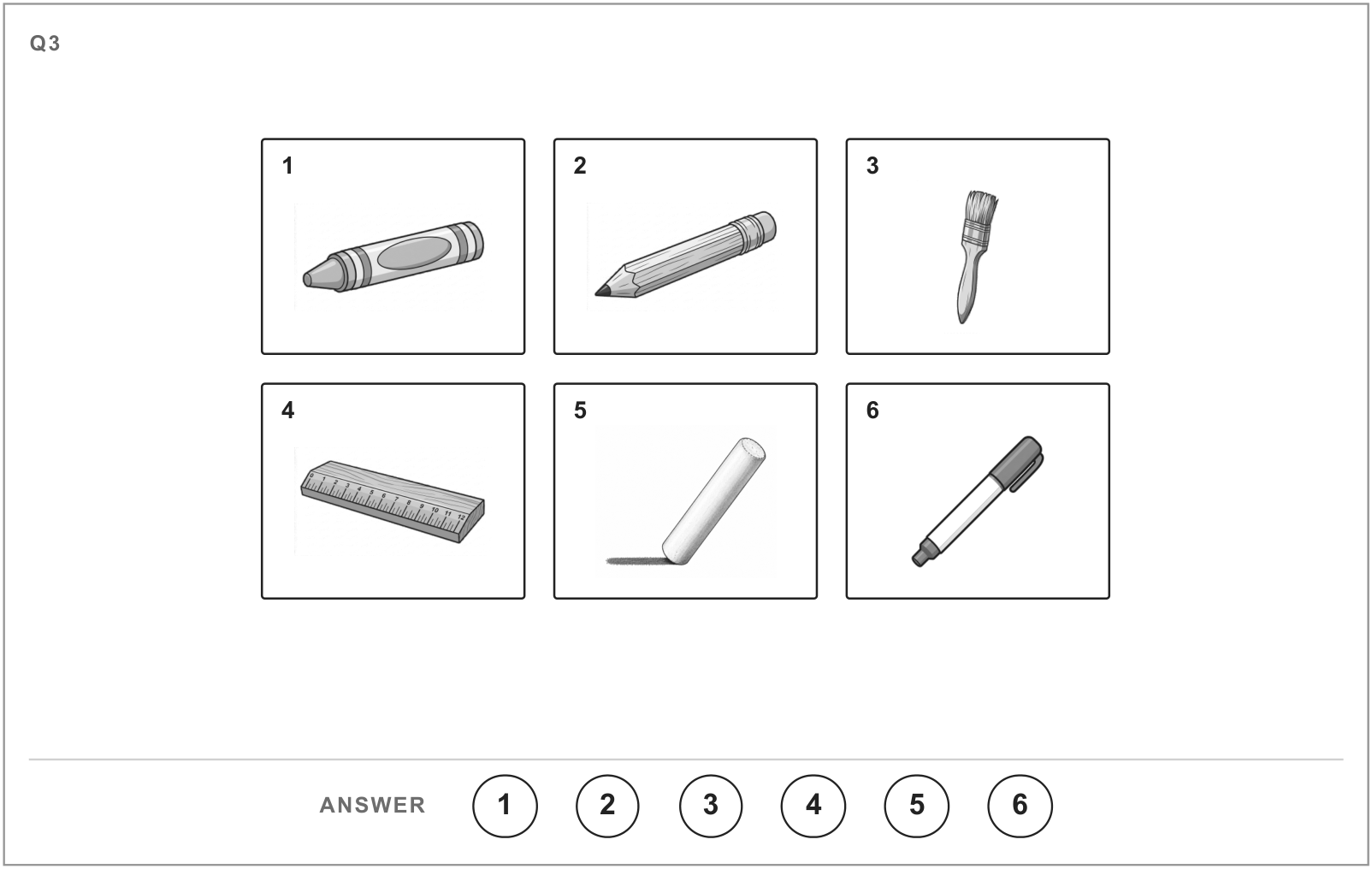
Answer 4. A pencil, crayon, chalk, paintbrush and marker make marks. A ruler measures or guides a line but does not make the mark.
Try 24 original workbook questions for 5th and 6th grade. These are independent practice questions, not official NGAT items. This set does not predict a score.
Text version (screen-reader friendly): NGAT Grades 5–6 practice test
| Test and publisher | Naglieri General Ability Tests · MHS |
|---|---|
| Grades | 5th grade and 6th grade |
| Areas | Verbal, Nonverbal and Quantitative. The school chooses which tests to give. |
| Each assigned test | 40 questions, up to 35 minutes |
This free set has eight sample questions in each area. See the sources in the Grades 5–6 guide.
The black-and-white PDF prints on US Letter paper. Give your child pages 2–13 and keep the explained answers on pages 14–16 for later. No email is required.
Download printable PDF ↓Text version (screen-reader friendly): NGAT Grades 5–6 practice test
A stretch question is the hardest in its section. It is fine to skip it.
Five pictures have something in common. Choose the picture that does not belong.
Answer 4. A pencil, crayon, chalk, paintbrush and marker make marks. A ruler measures or guides a line but does not make the mark.
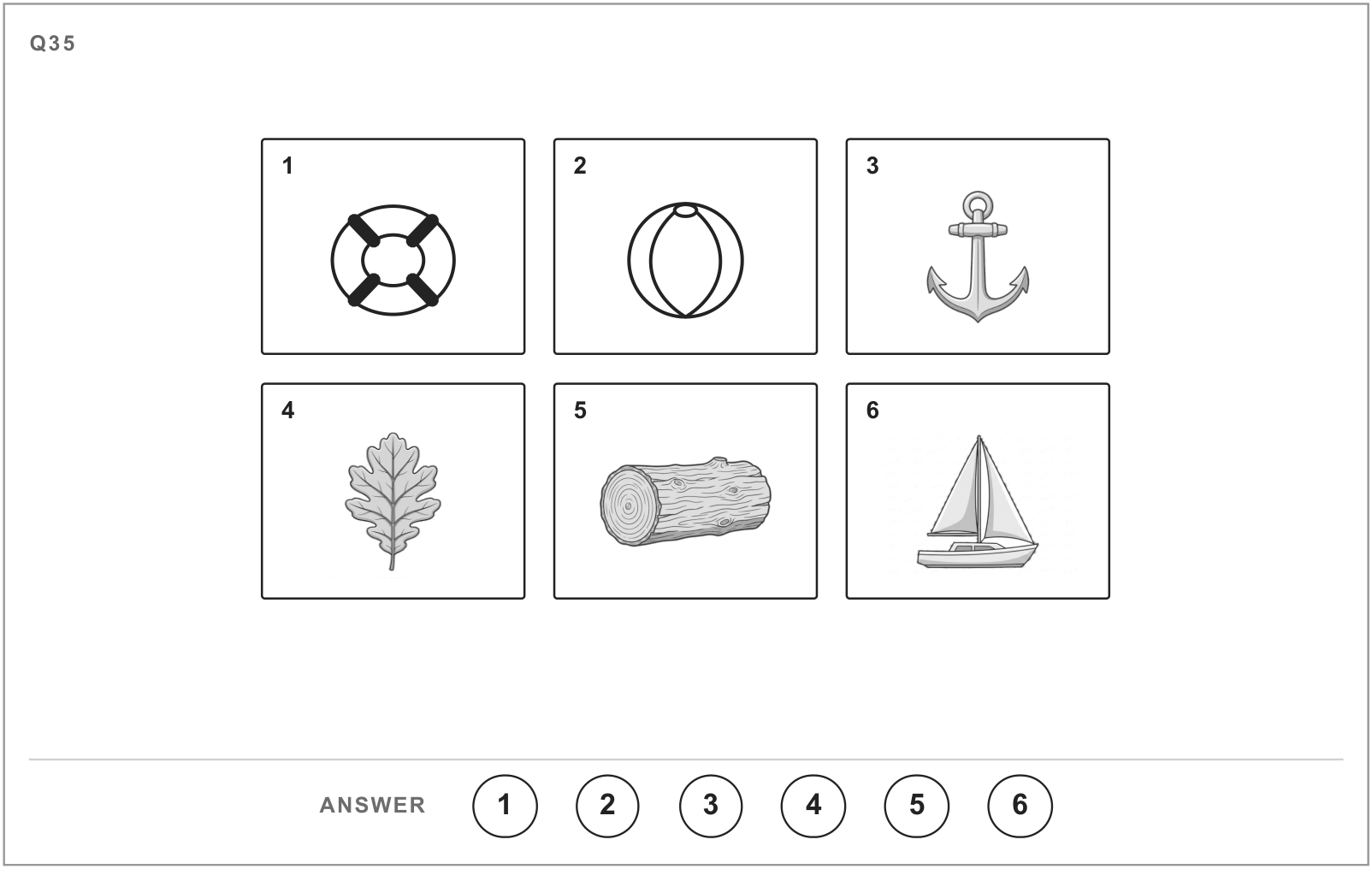
Answer 3. Five objects can float on water. The anchor is designed to sink.
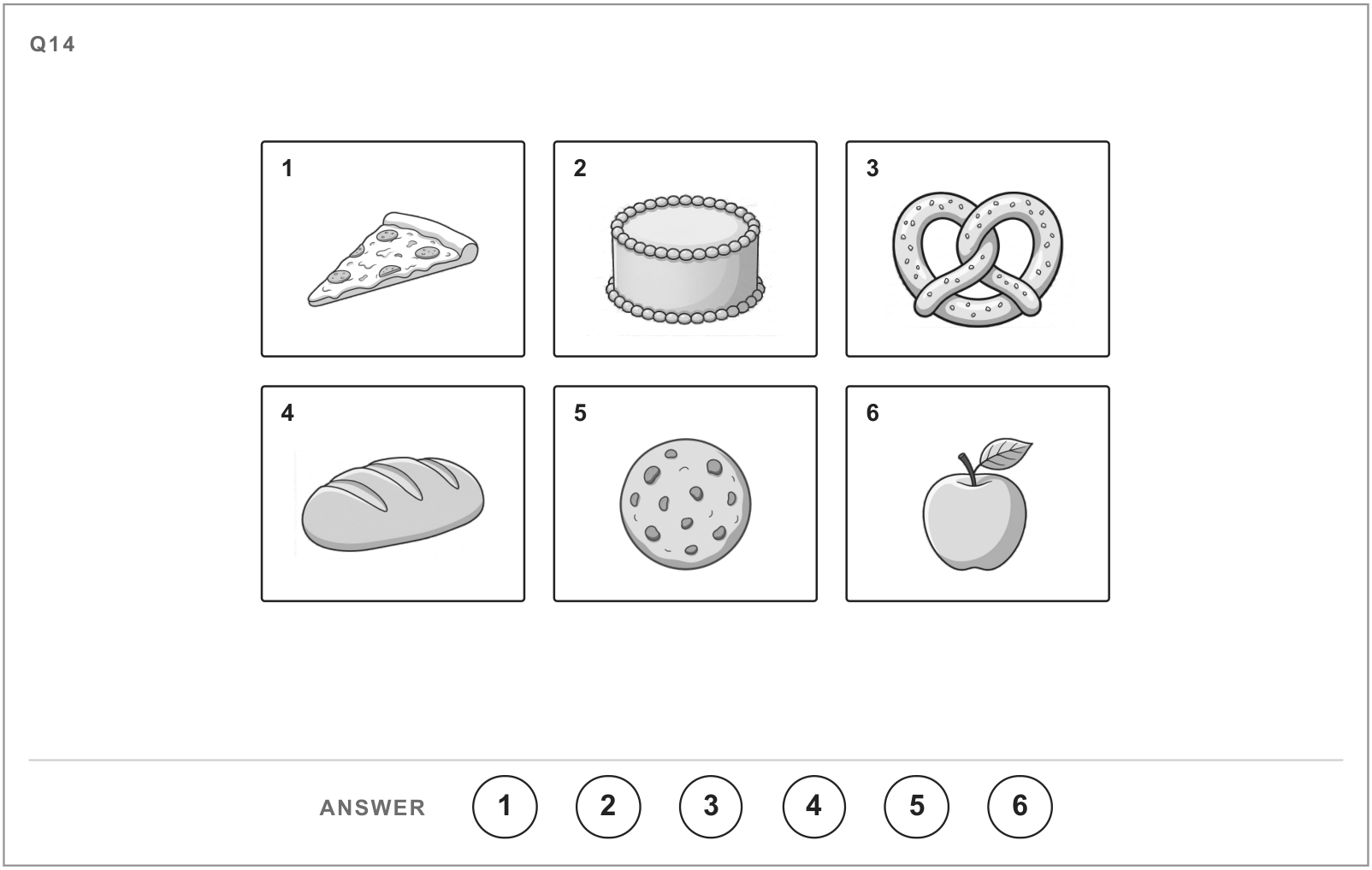
Answer 6. Five foods are baked. The apple is not.
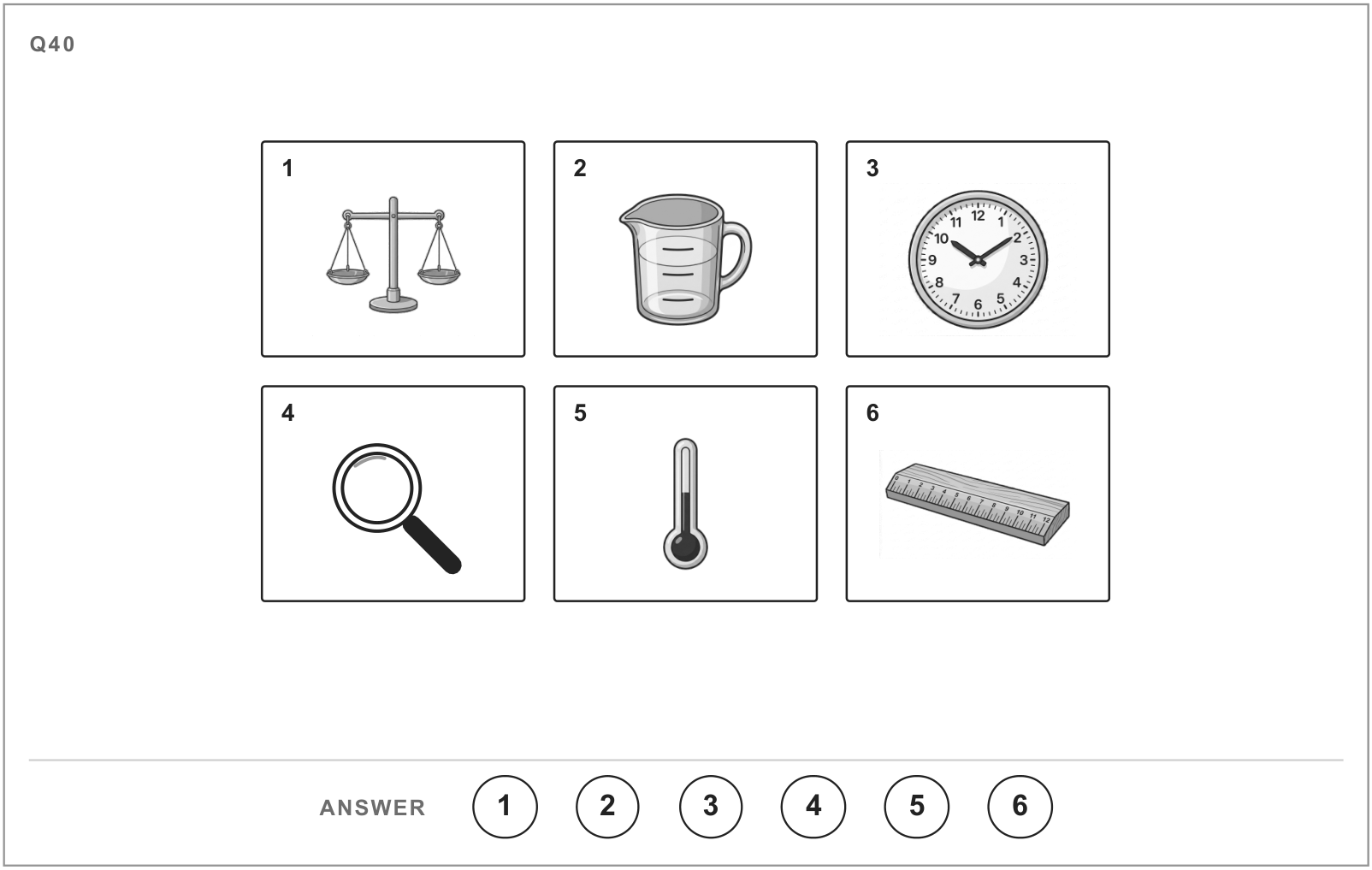
Answer 4. The ruler measures length, the clock time, the thermometer temperature, the scale weight and the marked cup volume. The magnifying glass makes details look bigger.
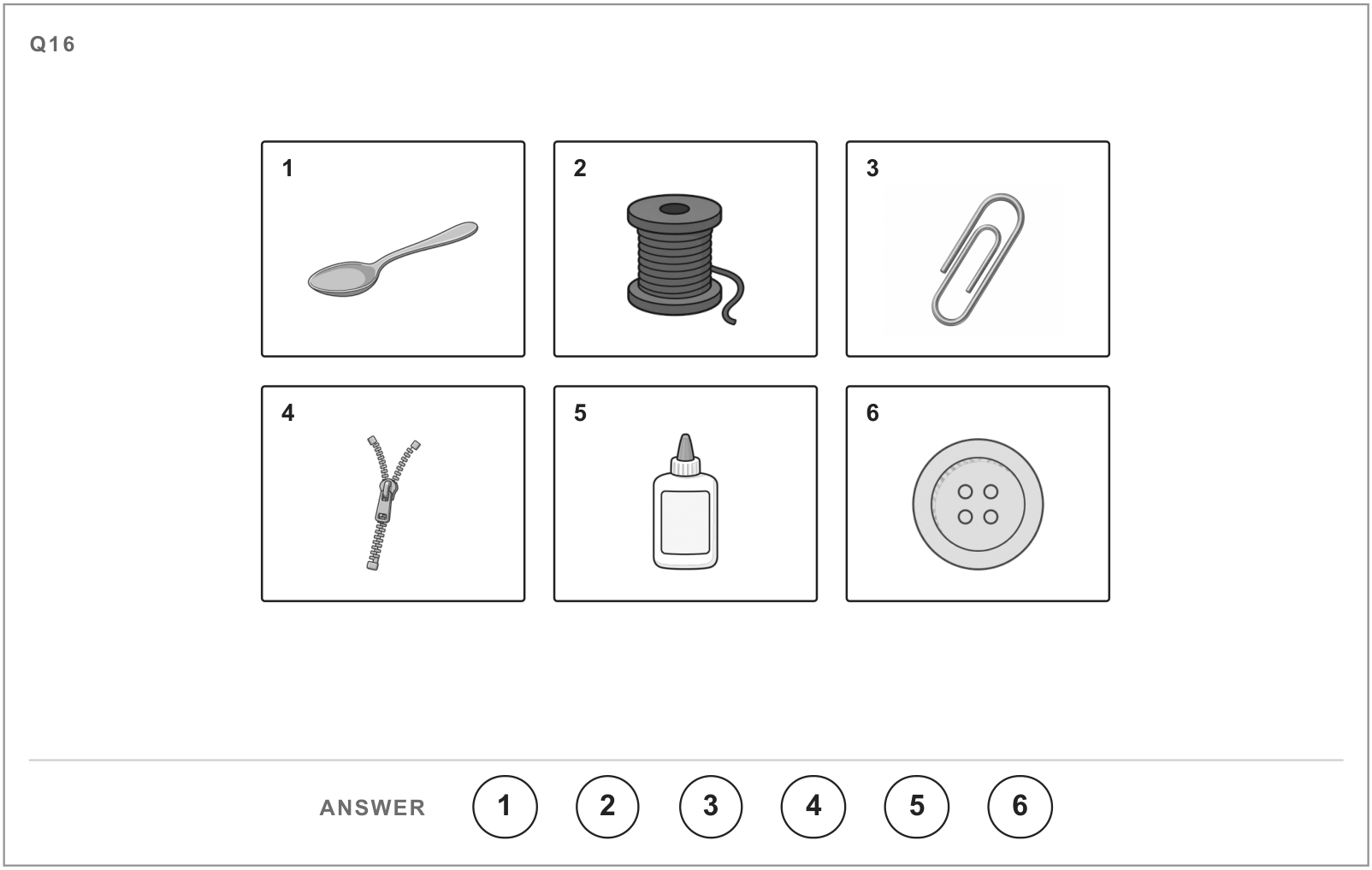
Answer 1. A paperclip, zipper, button, thread and glue help hold things together. A spoon is used for eating or stirring.
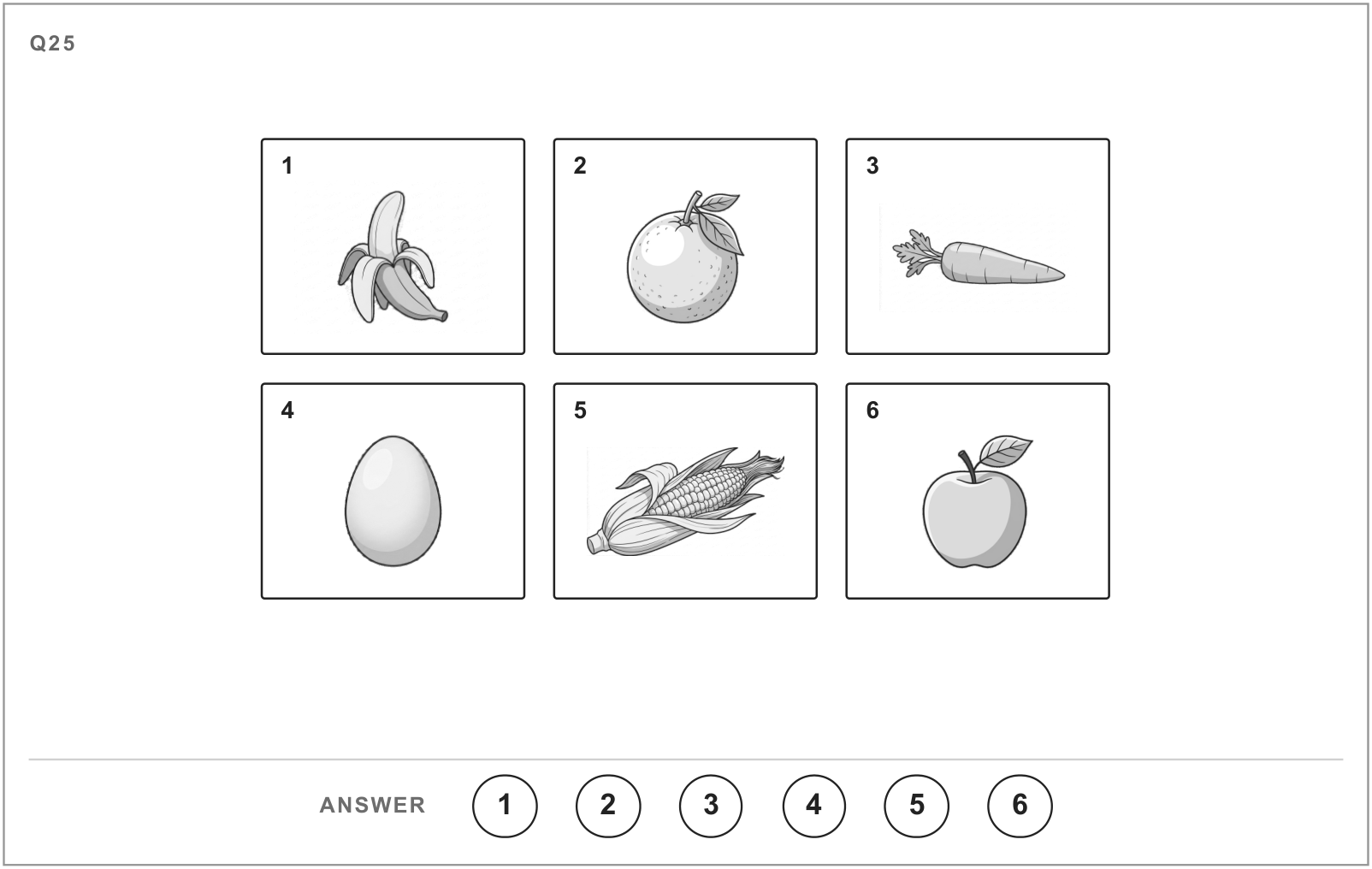
Answer 4. Five foods come from plants. The egg comes from an animal.
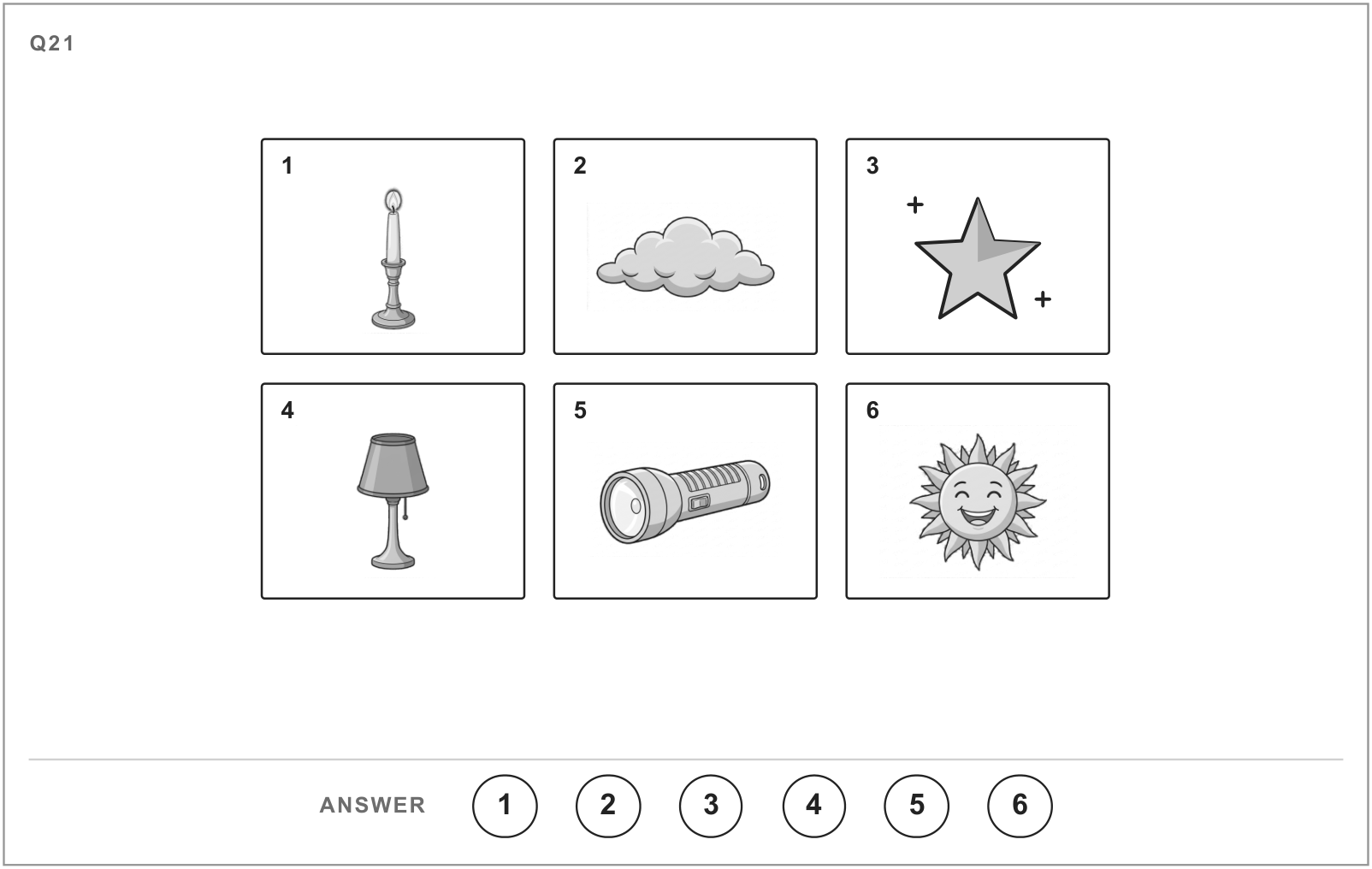
Answer 2. Five pictures show things that make light. The cloud does not.
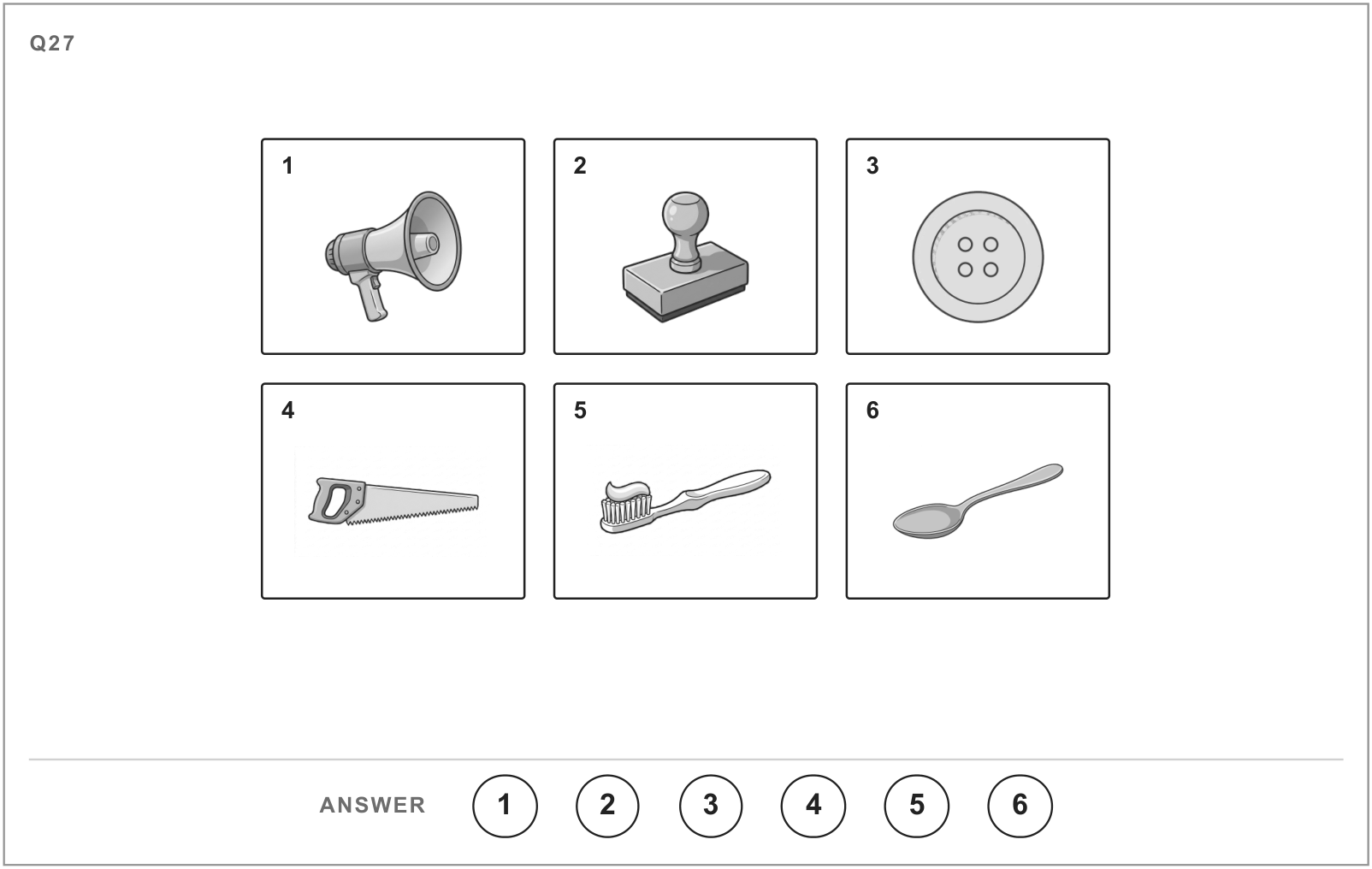
Answer 3. Five objects have handles. The button does not.
Look at the figures and choose the picture that goes in the box with the question mark.
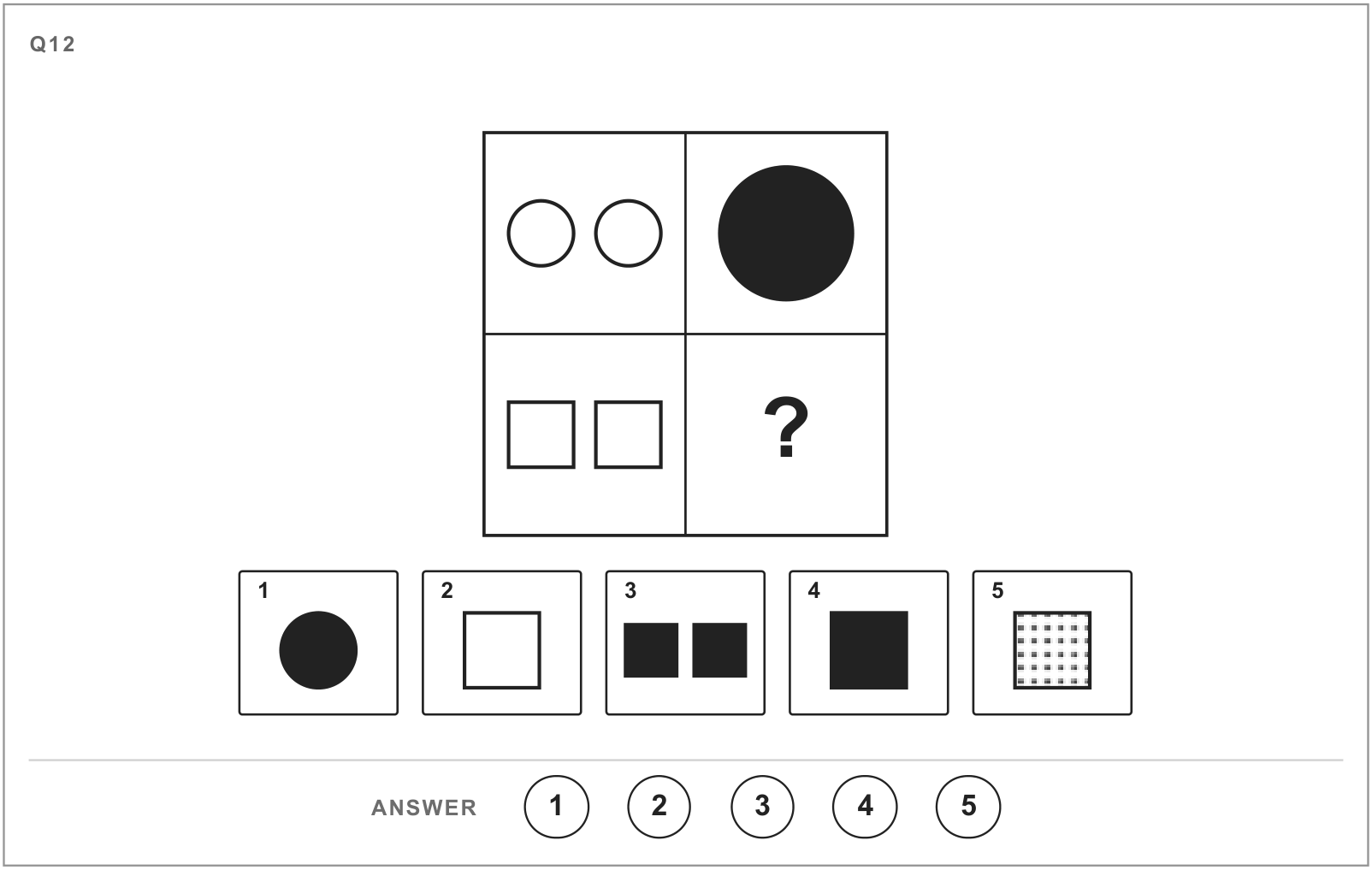
Answer 4. Two open circles became one solid circle, so two open squares must become one solid square.
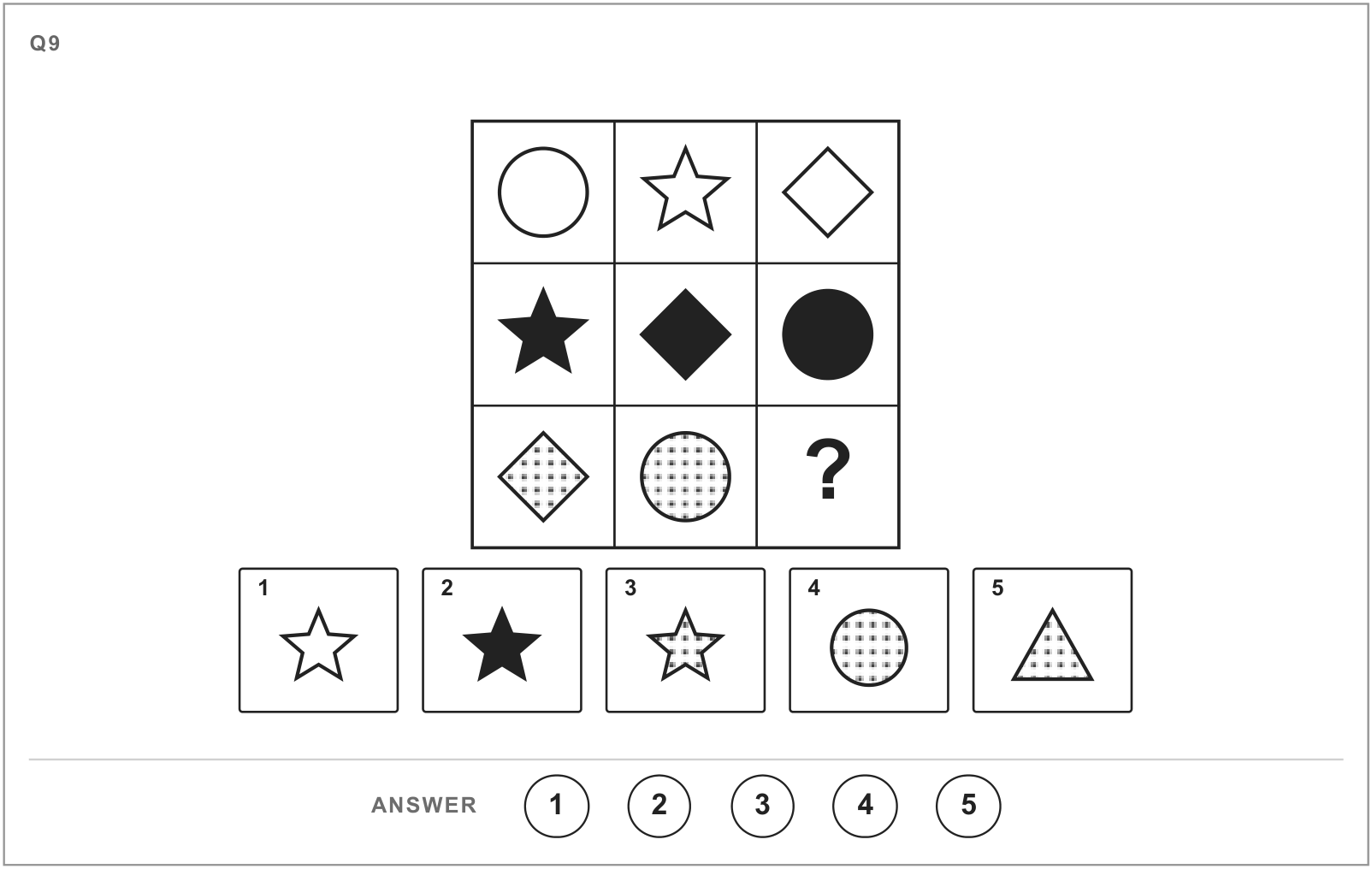
Answer 3. The last row needs the star to complete the shape distribution, and every cell in that row is dotted.
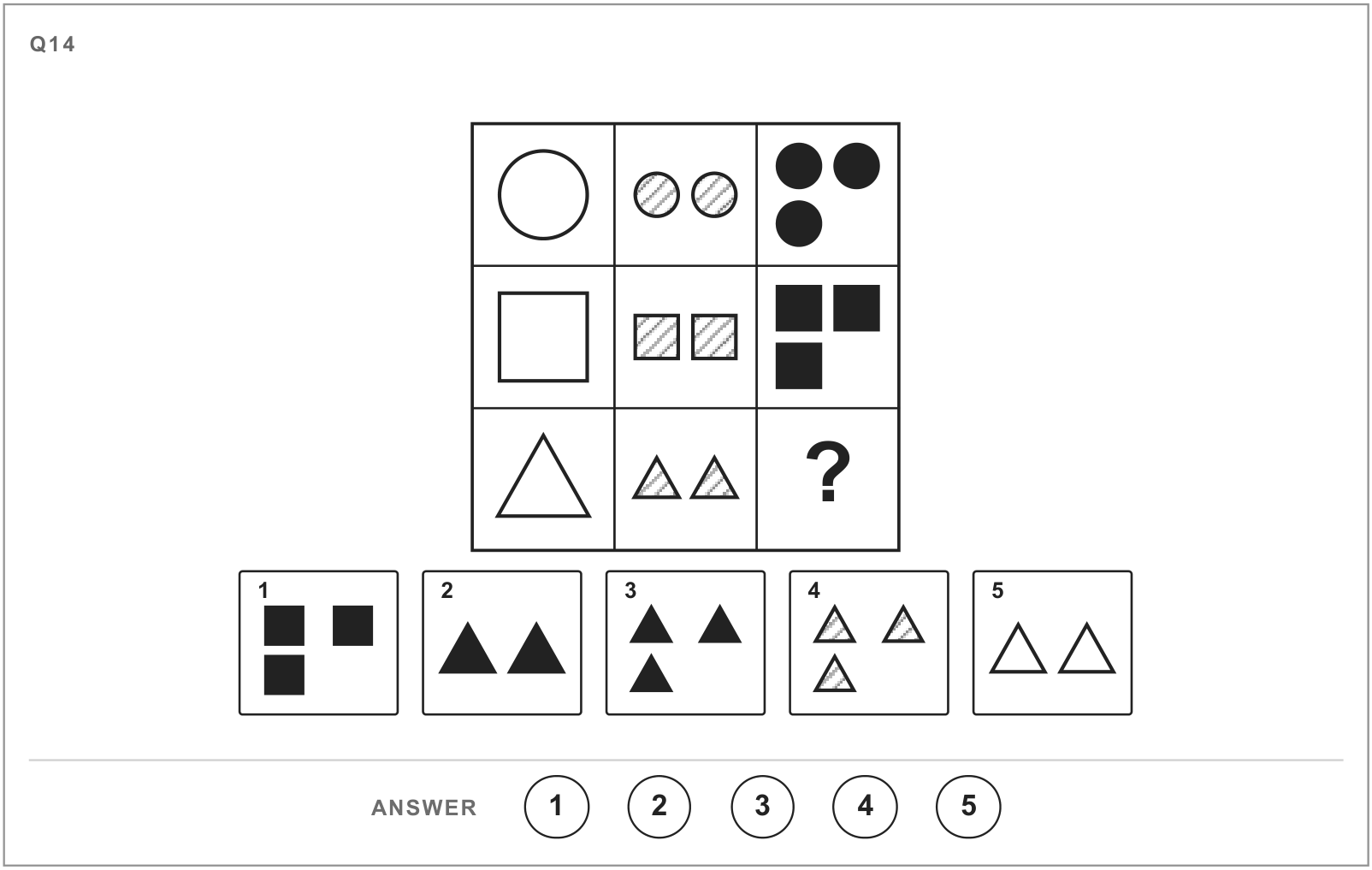
Answer 3. The triangle row reaches the third column, so it needs three solid triangles.
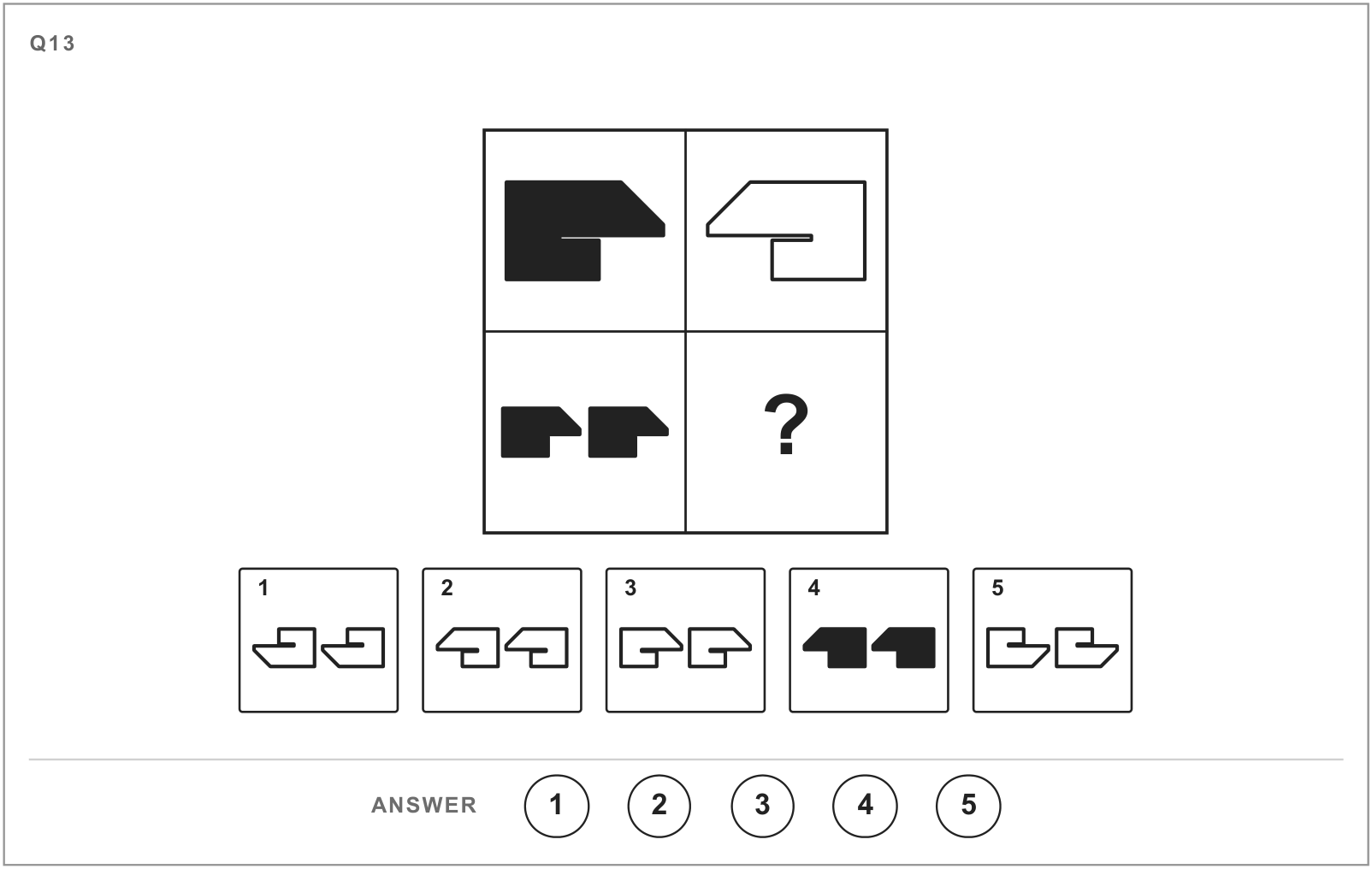
Answer 2. Reflect both lower L-shapes in an upright mirror and make them open. Keep two L-shapes.
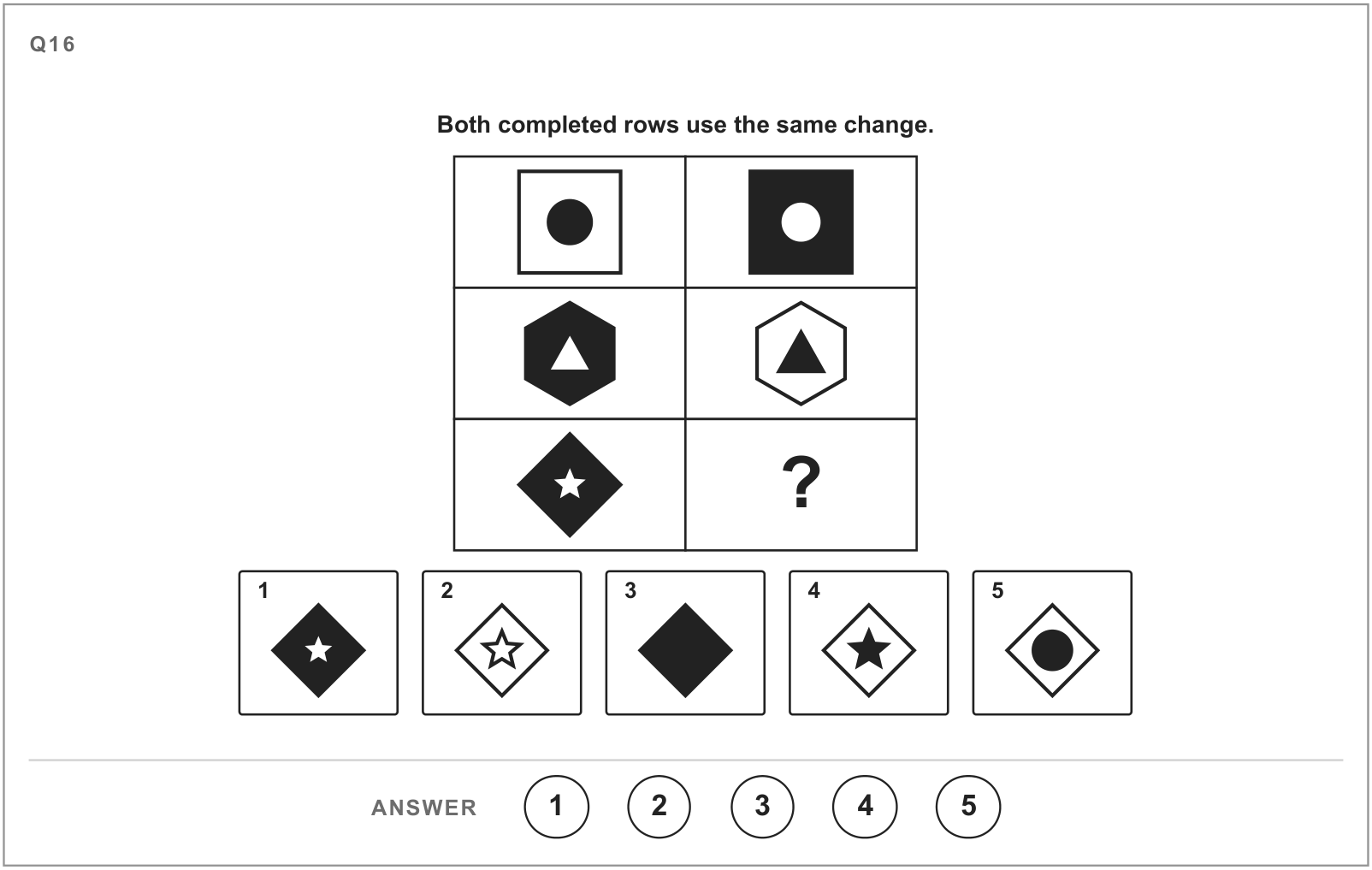
Answer 4. Both completed rows swap solid and open regions. Make the outer diamond open and its inner star solid.
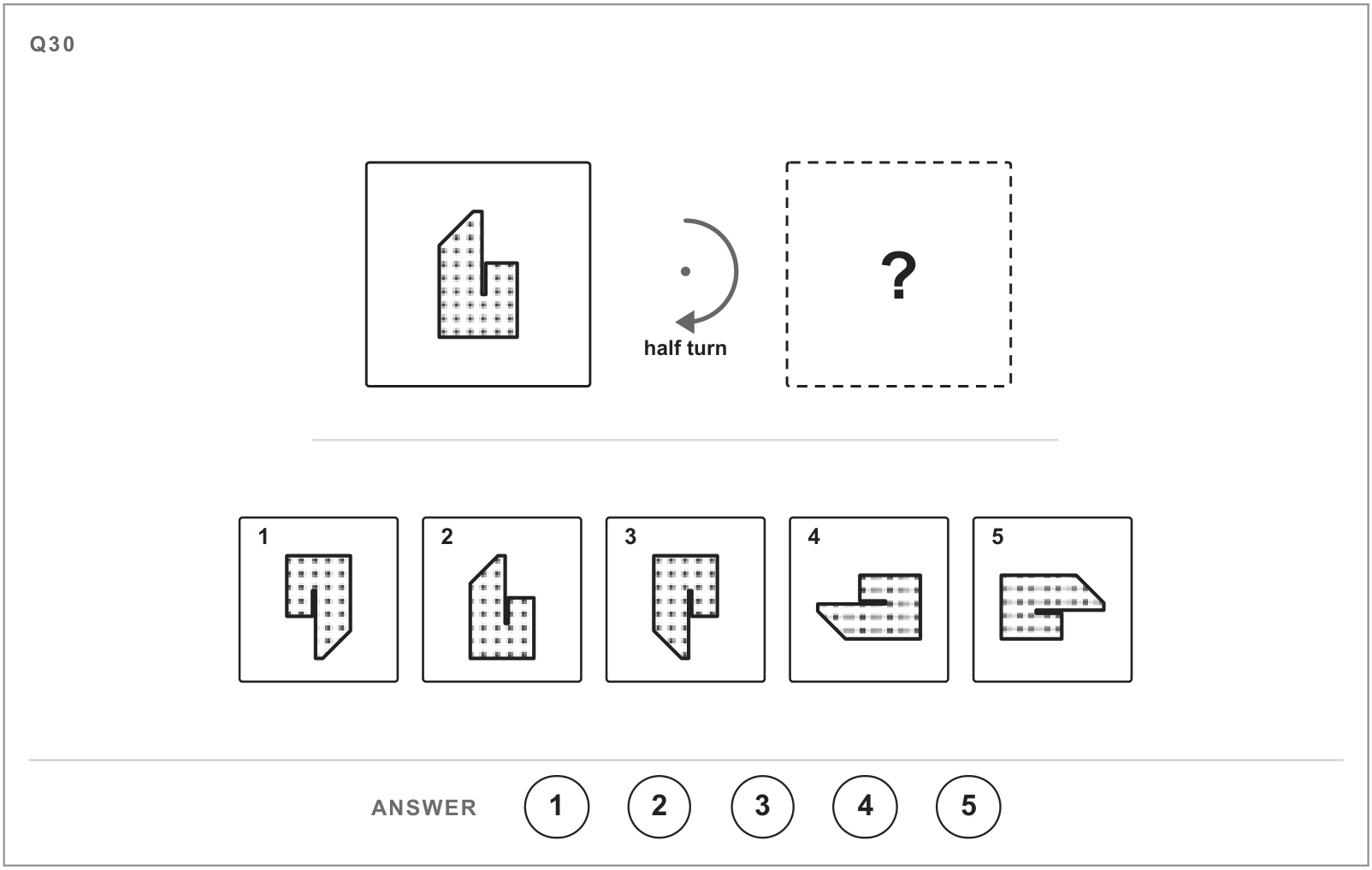
Answer 1. Turn the L halfway around in its own spot. Its long arm and short foot point opposite ways from the start, with no mirror flip.
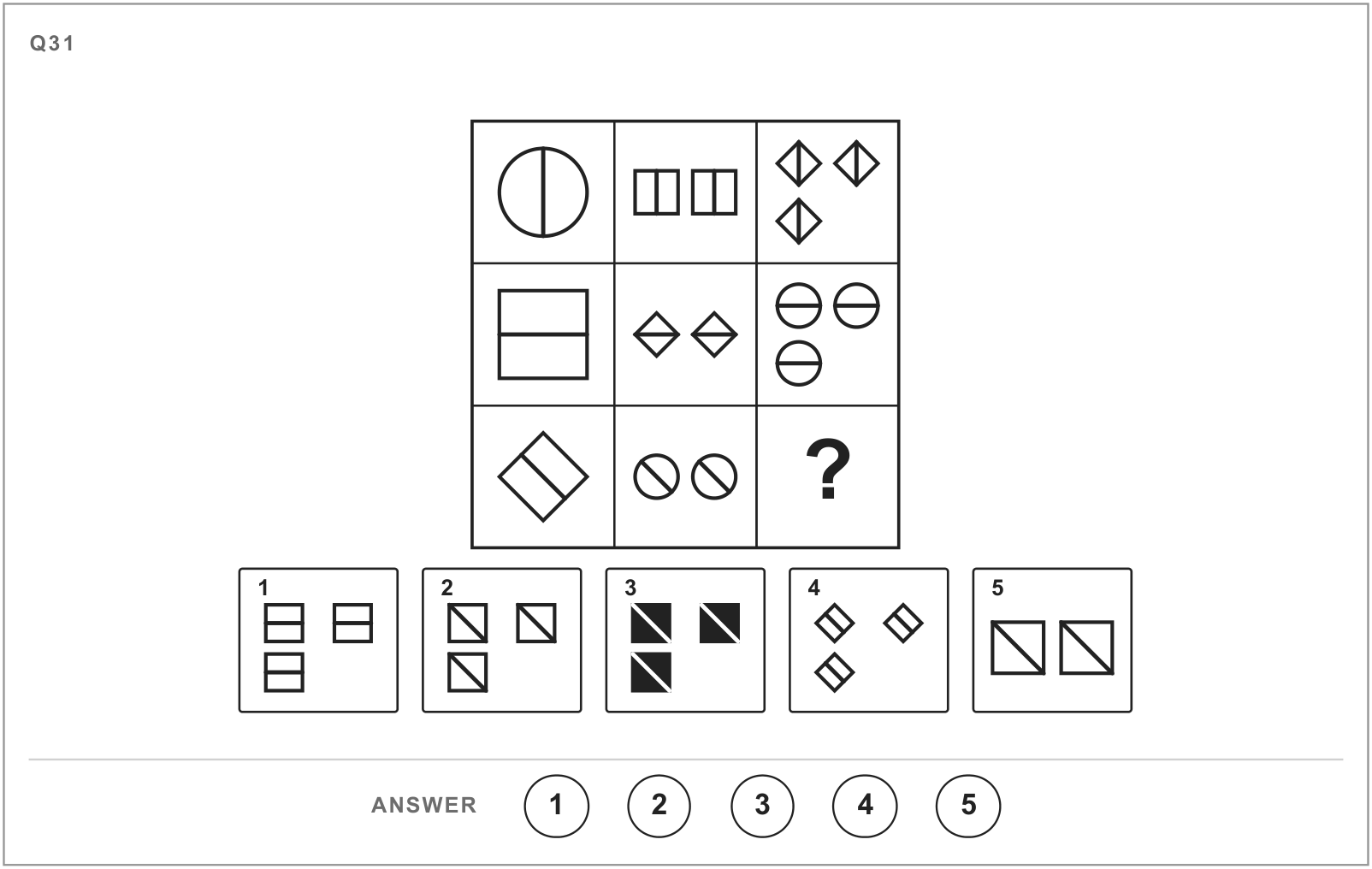
Answer 2. The missing cell uses the absent square, the bottom row's descending diagonal line, and the right column's count of three.
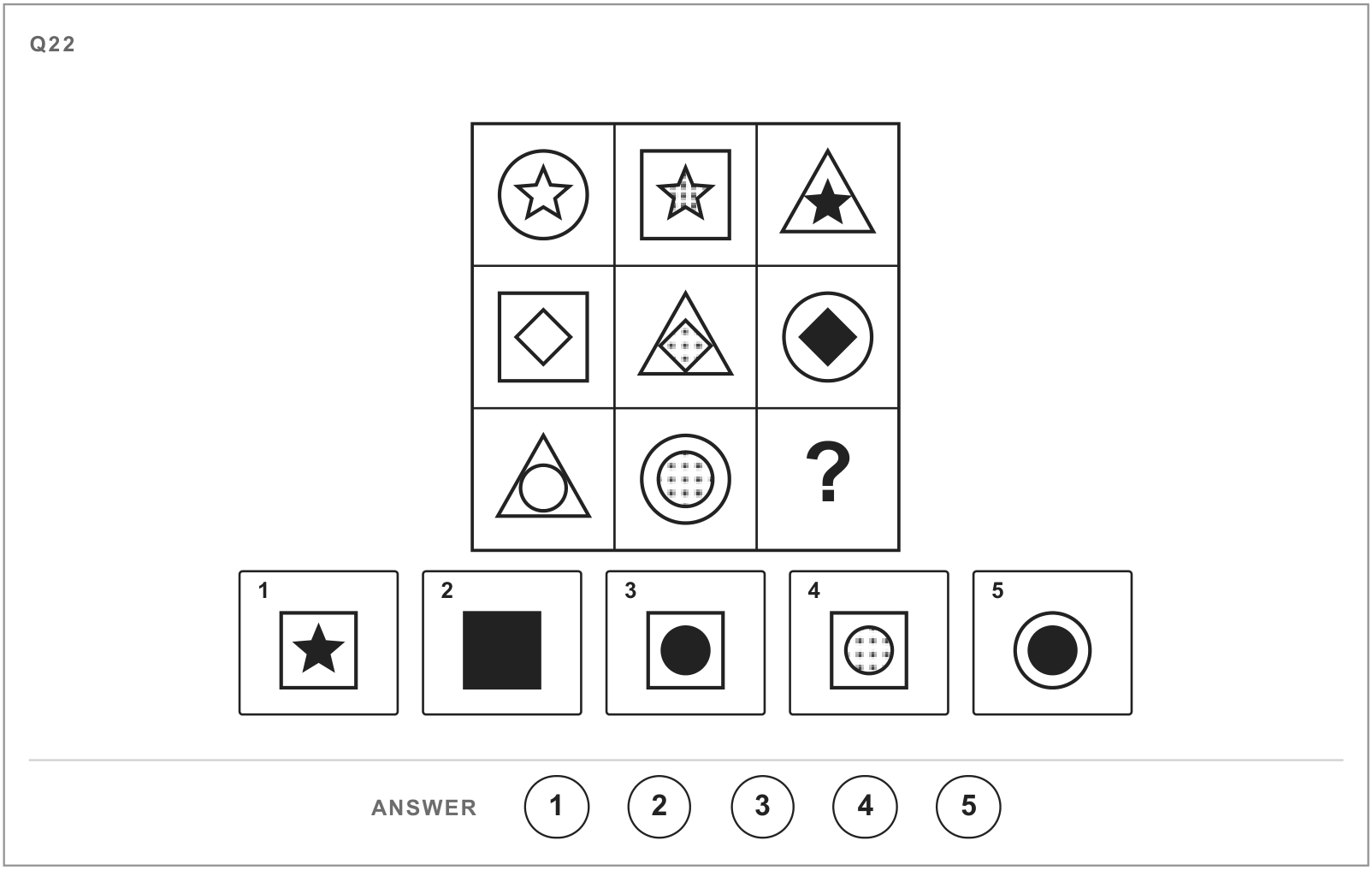
Answer 3. The missing outer shape must be the square, its row carries an inner circle, and the third column makes that inner circle solid.
Find the missing number or picture. Where a direction is printed, follow it.
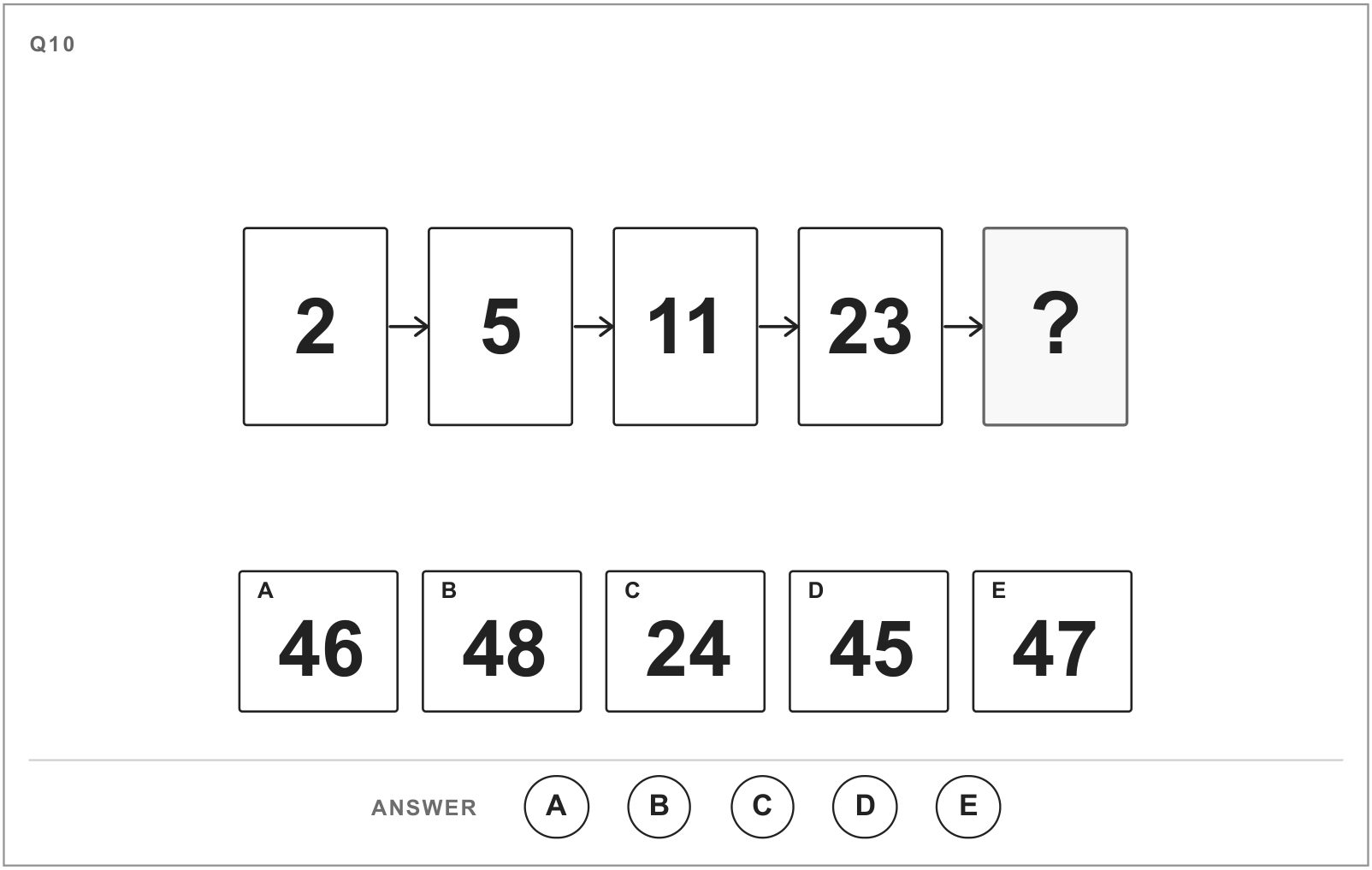
Answer E. Two becomes five, five becomes eleven, and eleven becomes twenty-three; twice twenty-three plus one is forty-seven.
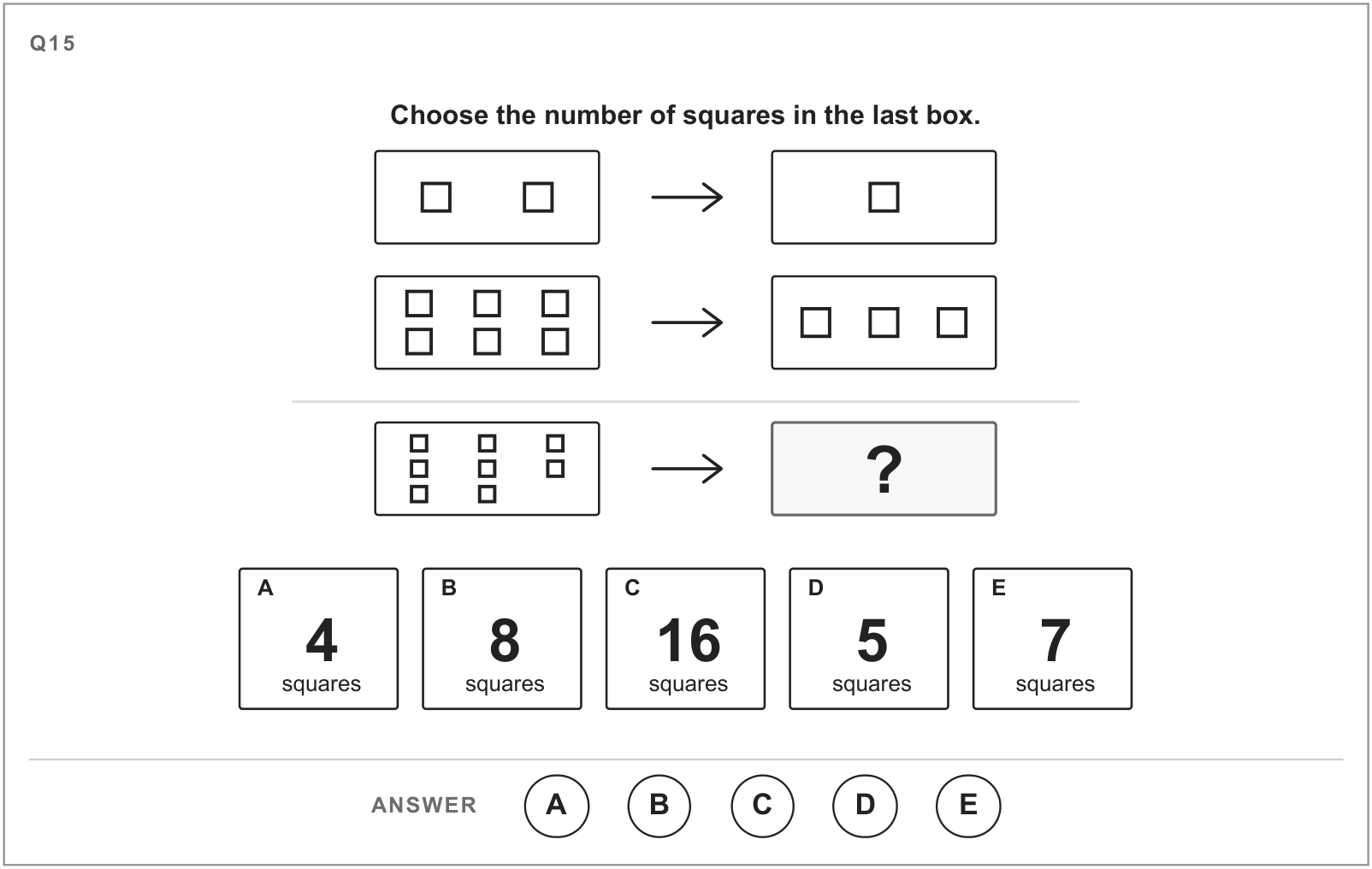
Answer A. Two becomes one and six becomes three, so eight becomes four.
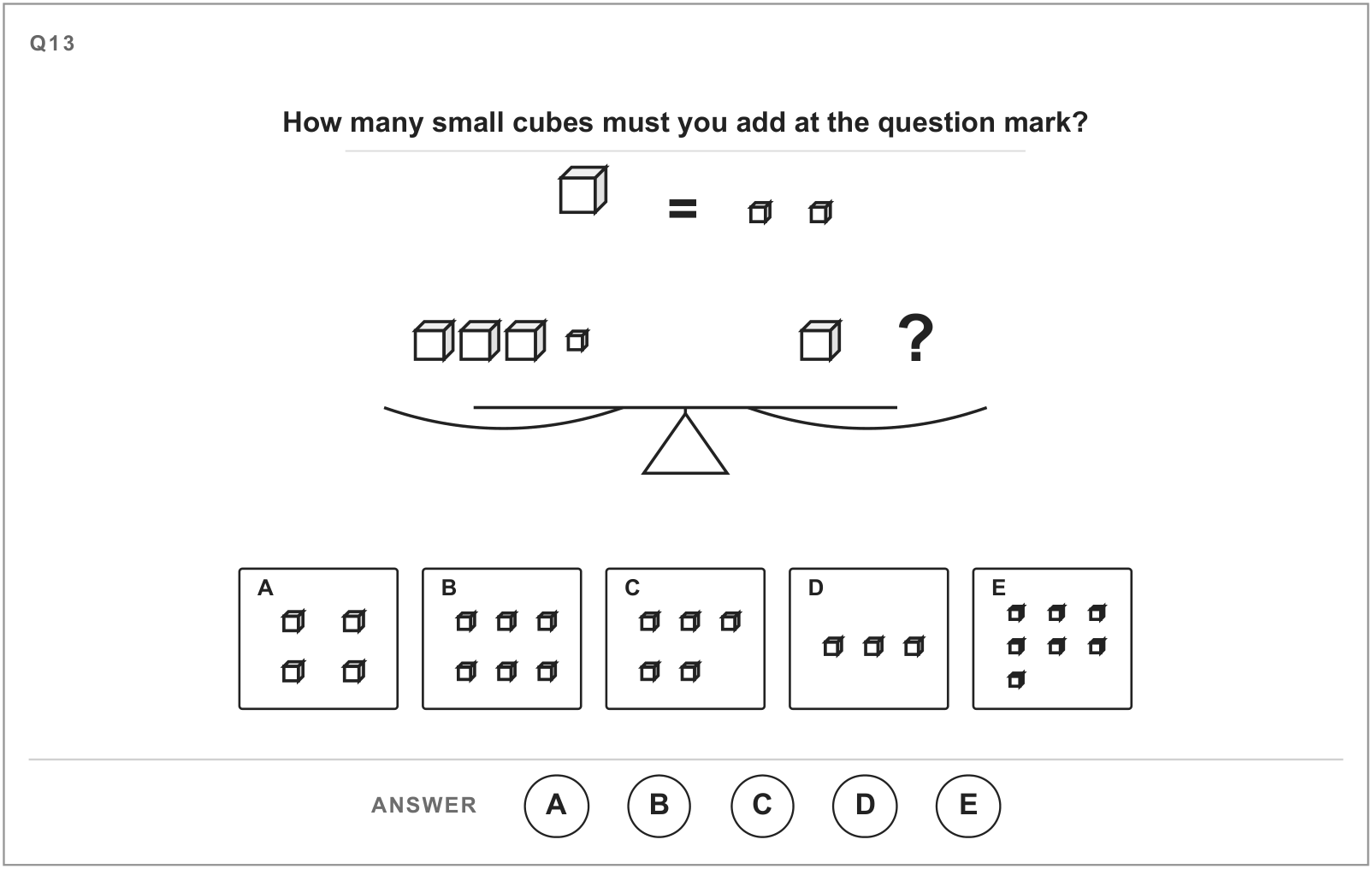
Answer C. The left weighs seven. One large cube on the right weighs two, so five small cubes are needed.
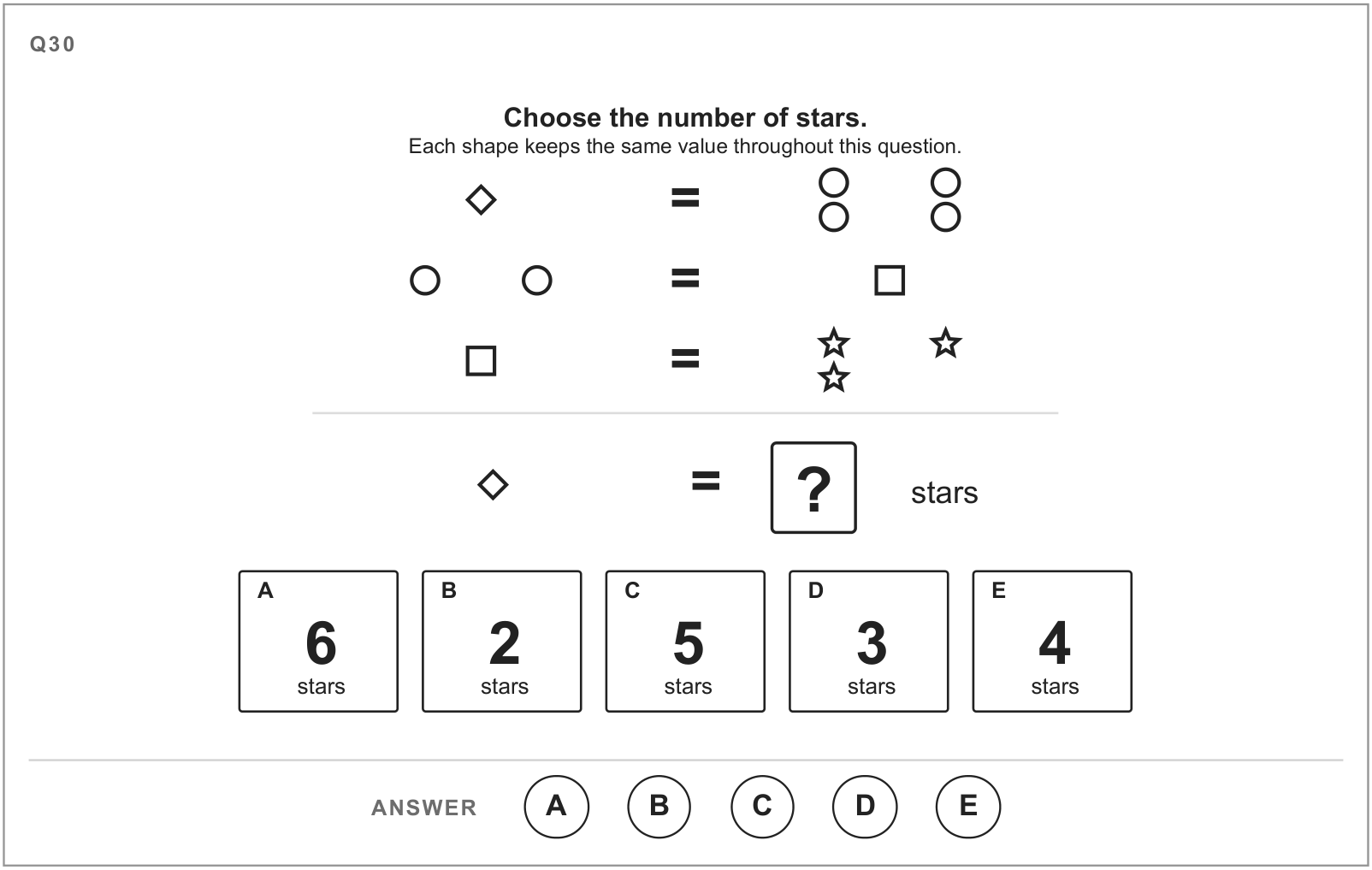
Answer A. One diamond makes four circles, then two squares, then six stars.
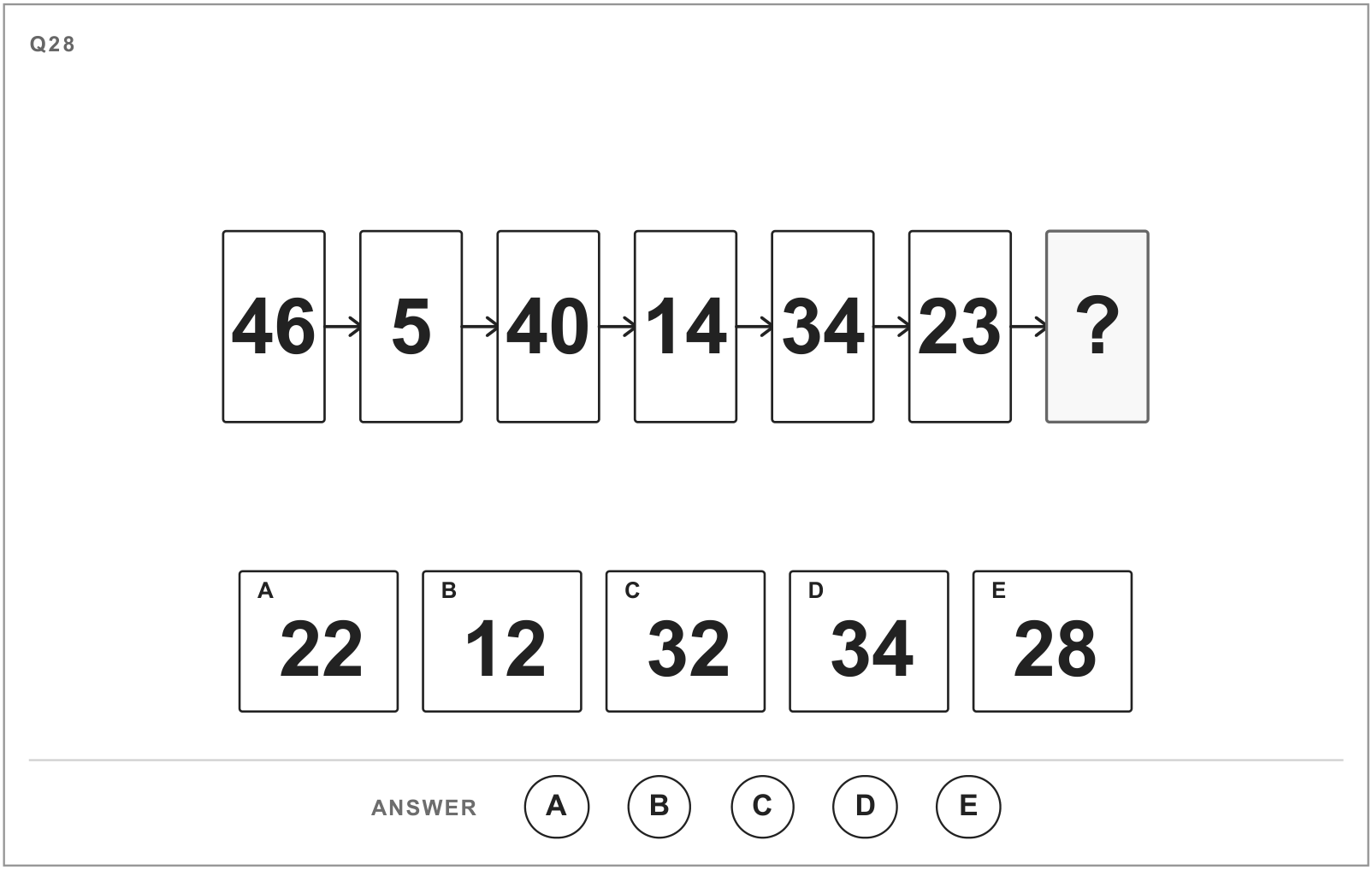
Answer E. The odd-position stream is 46, 40, 34, so it continues to 28. The alternating stream is 5, 14, 23.
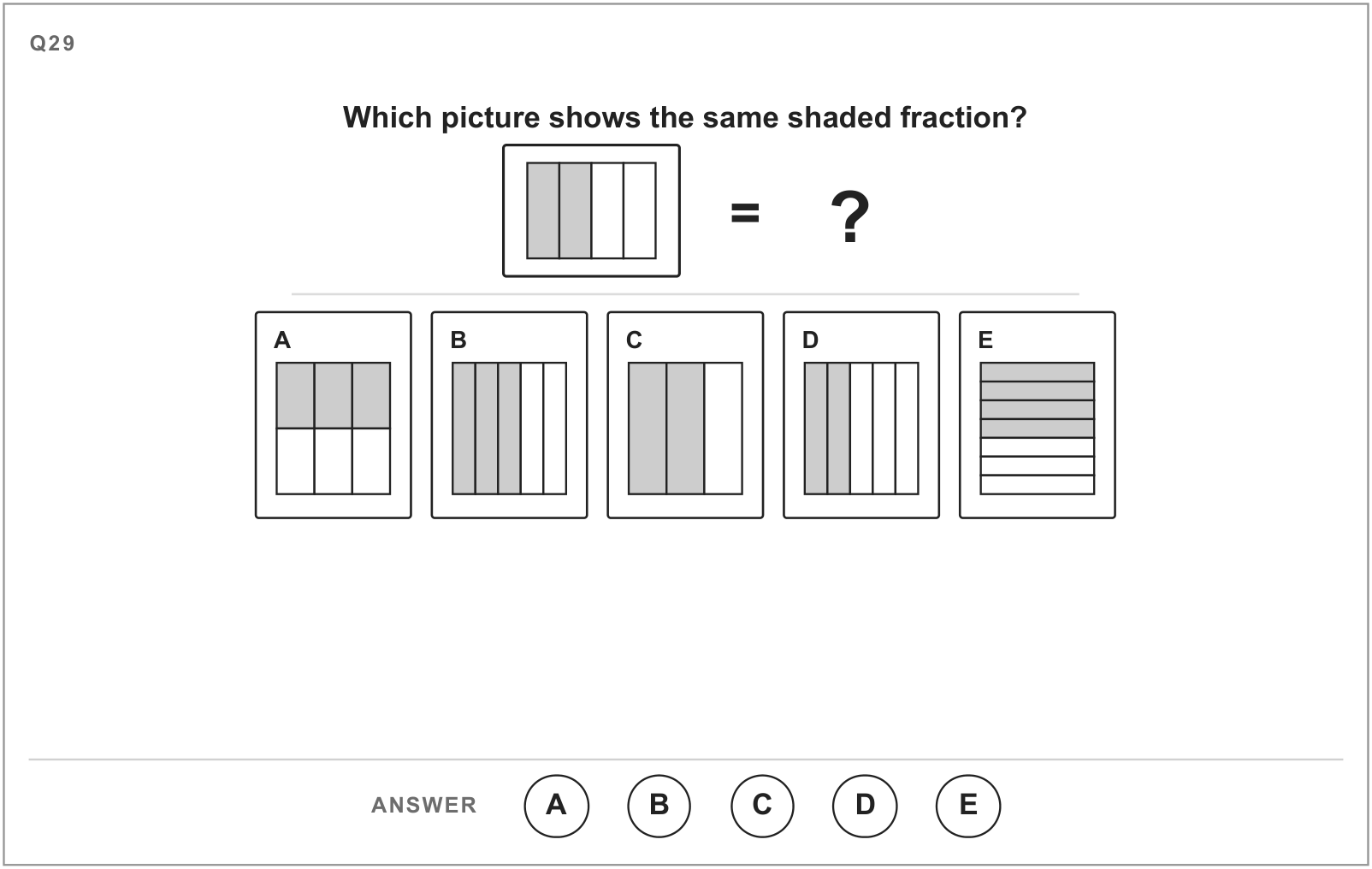
Answer A. Choose the equal-part model equivalent to one half.
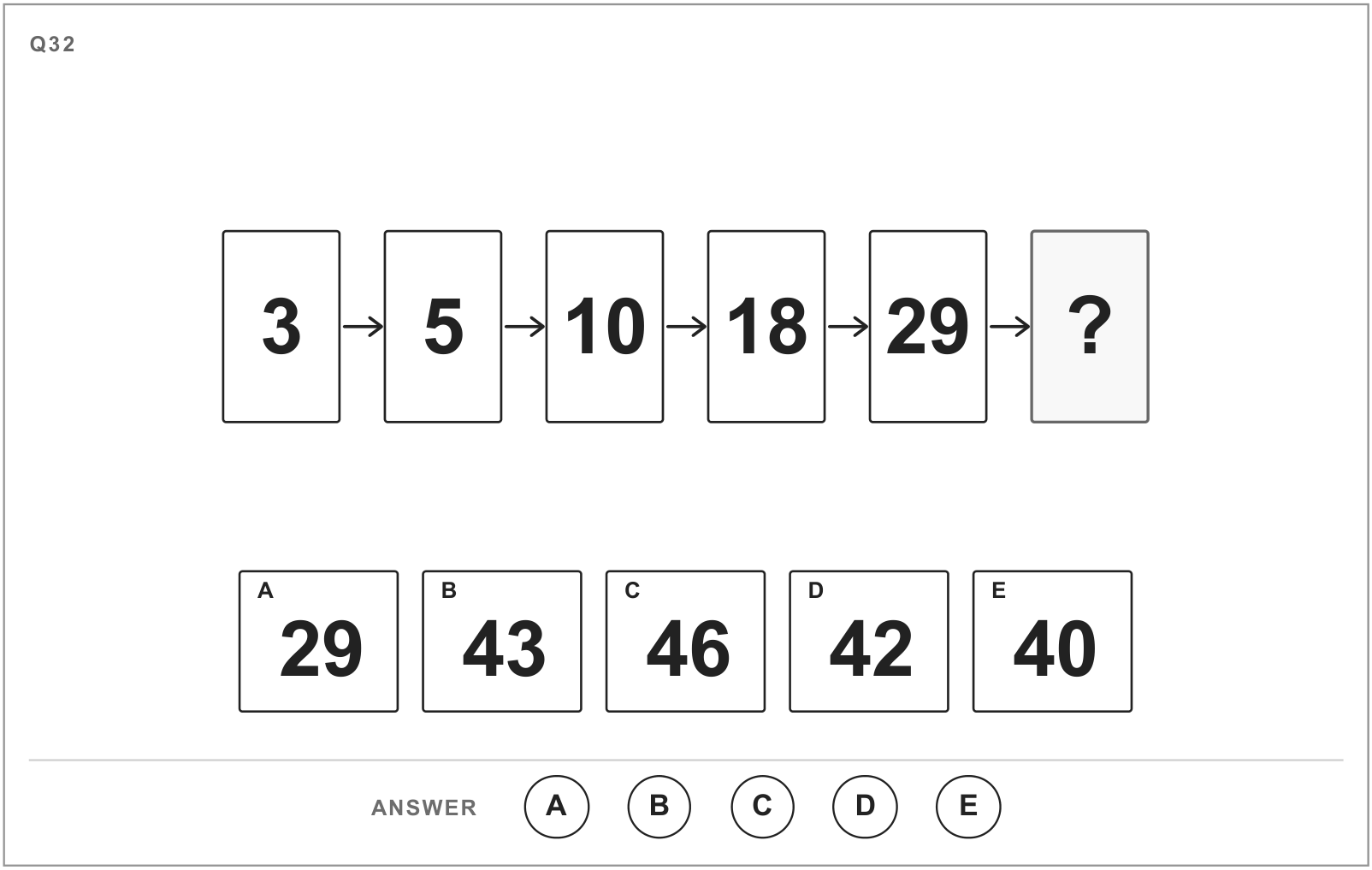
Answer B. The increase grows by three each time. Adding fourteen to 29 gives 43.
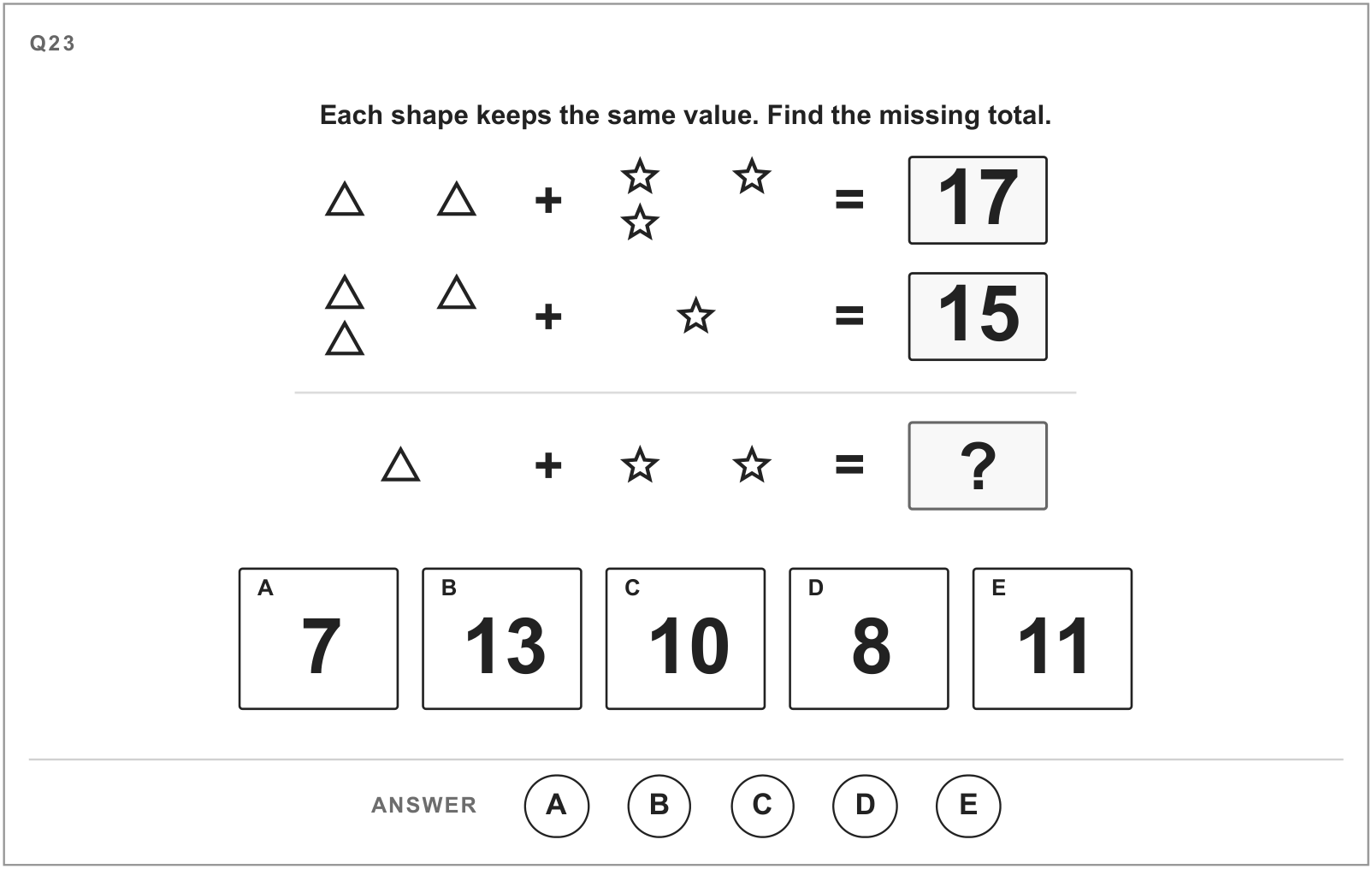
Answer C. A triangle is worth four and a star is worth three. One triangle and two stars total ten.
Let your child choose an answer before opening the explanation. Ask “What did you notice?” If two choices looked possible, revisit them together and check each one against the whole picture. Stop after a few questions or return to another section later.
No. These are original Reasonwell Press questions from the published Grades 5–6 workbook. They are not official NGAT questions, and this practice set does not predict a score.
The verbal task asks children to recognize a concept that several pictures share. Here, your child looks at six everyday things and picks the one that does not belong with the other five.
The school chooses which of the three tests to give. Check the school notice to see which areas your child will take and what the school advises about preparation.
The publisher has grade-specific forms. Fifth and sixth graders can both use this workbook practice set.
No. Look for the full test name on your school notice. This page covers the Naglieri General Ability Tests (NGAT), published by MHS. A notice naming NNAT refers to a different test.
Six actual workbook pages: twelve questions across all three reasoning areas, with explained answers.
Download sample (PDF) ↓Text version (screen-reader friendly): NGAT Grades 5–6 workbook sample
Download NGAT Grades 5–6 workbook sample ↓10 pages · 5.3 MB · No email requiredText version (screen-reader friendly): NGAT Grades 5–6 workbook sample
Naglieri General Ability Tests™ (NGAT) is a trademark of Multi-Health Systems Inc. (MHS), used for identification. Reasonwell Press is independent and is not affiliated with or endorsed by MHS or the test authors. These original practice questions are not actual test items and do not predict scores or guarantee placement.