A reasoning test with no words.
Pearson’s manual describes the NNAT3 as a brief, nonverbal measure of general ability that can be given to a group, online or on paper. Every question is an abstract design with a piece missing or a pattern to continue. The child picks the answer that completes it.
The teacher reads the directions aloud and leads the class through sample questions. After that, students work on their own. Nothing on the test asks a child to read, write or calculate, which is one reason districts use it for children who are still learning English.
Which level will your child take?
The lower levels of the NNAT3 are lettered A to D, one per grade until Grade 3. Pearson gives each of these levels two forms of 48 questions.
Third and fourth graders share Level D. Separate levels, E to G, cover Grades 5 to 12 and have their own manual. The school chooses the level, so confirm it on the notice if your child is working above or below grade.
48 questions. 30 minutes to work.
- 48 questions on each form, all multiple choice.
- 30 minutes of working time, which starts after the sample questions. The manual puts the whole session at about 35 to 45 minutes with directions.
- Not a speed test. Pearson calls it a power test: the questions get harder, and the time is meant to be enough for most students to try them all.
- Five colors. The designs use black, white, yellow, blue and green, chosen so that children with color blindness can tell them apart.
- Online or paper. The school decides which.
Four puzzle types.
Practice books, ours included, usually sort NNAT questions into four types. This is a teaching grouping. Pearson’s manual does not name these types or say how many of each appear, so treat any book that prints exact counts with caution.
The four drawings below are simple illustrations made for this page. Real workbook questions follow in the next section.
Pattern completion
A piece is missing from a larger design. Here the stripes carry on behind the gap, so the missing piece is blue on the left and yellow on the right.
Reasoning by analogy
The top row shows a change, and the bottom row must make the same change. The small circle grows, so the small square becomes a large square.
Serial reasoning
A sequence shifts step by step across the rows. Each row moves the shapes one place to the right, so the last square needs the circle.
Spatial visualization
Shapes are combined, turned or folded in the mind. Lay the circle on the square and you get a blue square with a yellow circle in the middle.
Six questions from the workbook.
These come from the practice sets in our NNAT3 Level D workbook, shown as they are printed. They are original practice questions, not questions from the real test. The book’s two full practice tests are not shown here.
Look at every choice, say the rule aloud, then open the answer.
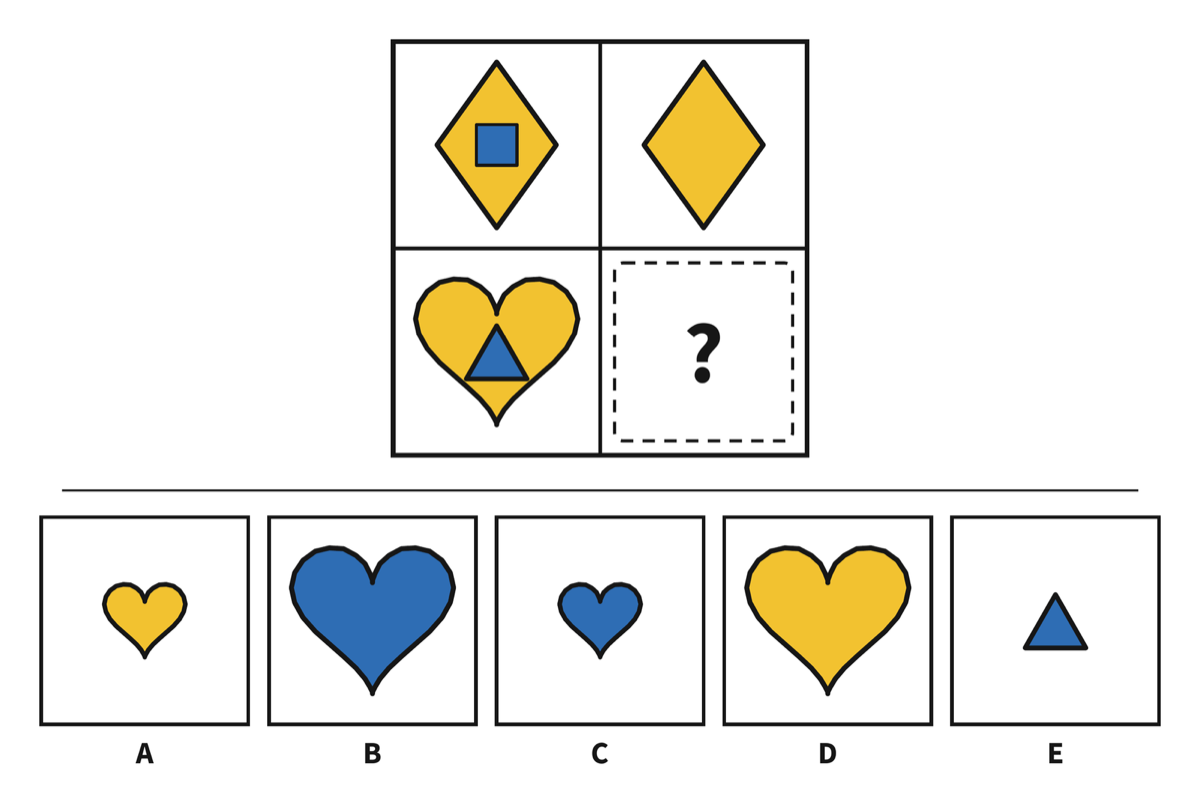
Question 1
See the answer and rule
Answer D. This kind of puzzle is called “Something is taken away” in the workbook.
In the top row, the small shape inside is taken away. The big shape stays exactly the same. Take away the small shape from the bottom picture. The missing picture is a yellow heart: choice D. Choice A takes away the small shape but shrinks the big one. Choice B takes away the small shape but changes the color. Choice C has the wrong color (blue) and the wrong size (too small). Choice E takes away the big shape instead of the small one.
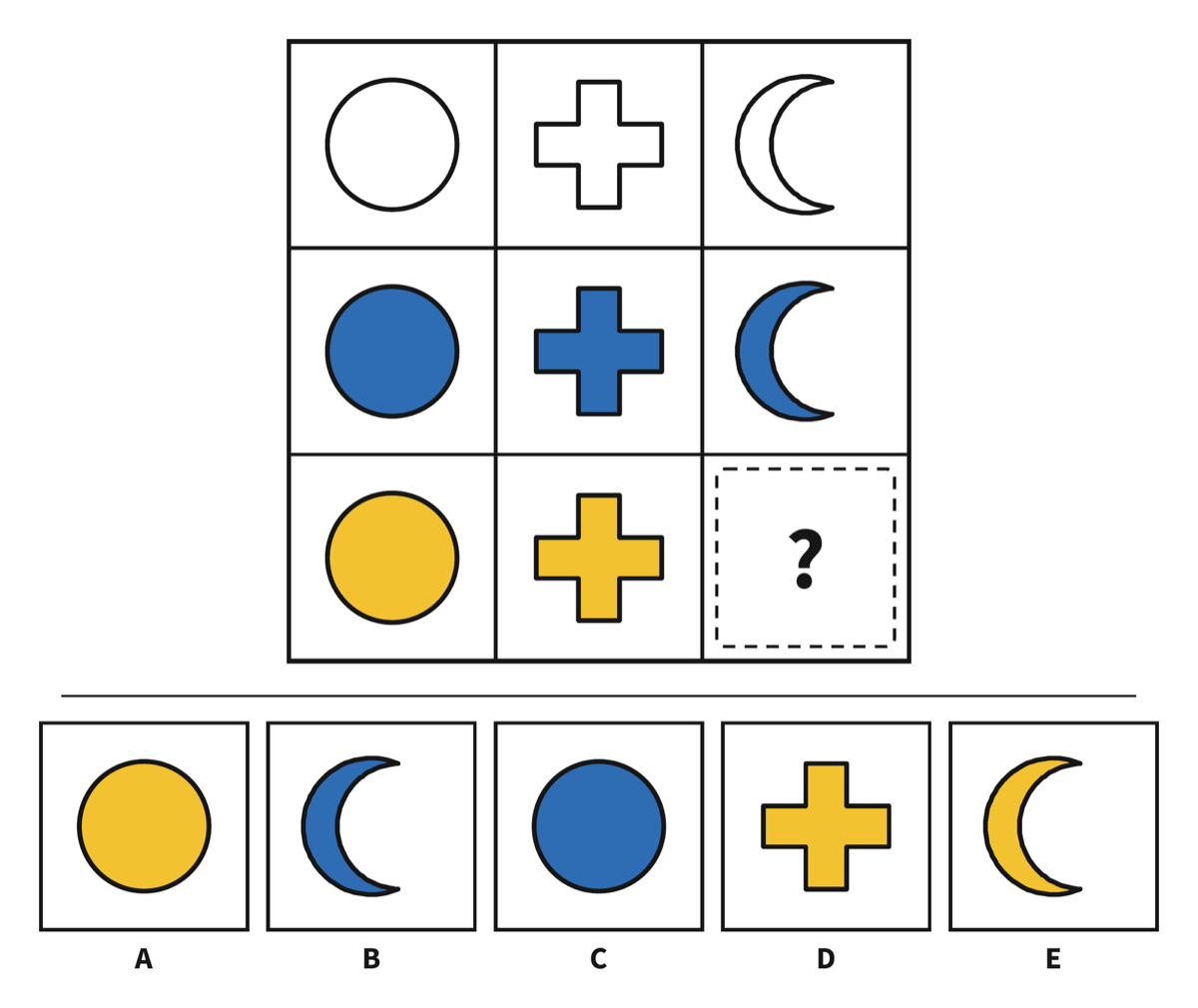
Question 2
See the answer and rule
Answer E. This kind of puzzle is called “Rows and columns each have a job” in the workbook.
Each column keeps the same shape, and each row keeps the same color. The missing box is in the right column, so it is a moon, and it is in the bottom row, so it is yellow. The missing picture is a yellow moon opening to the right: choice E. Choice A has the wrong shape. Choice B has the color of the middle row instead of the bottom row. Choice C has a shape and a color from the wrong places. Choice D has the shape from the middle column instead of the right column.
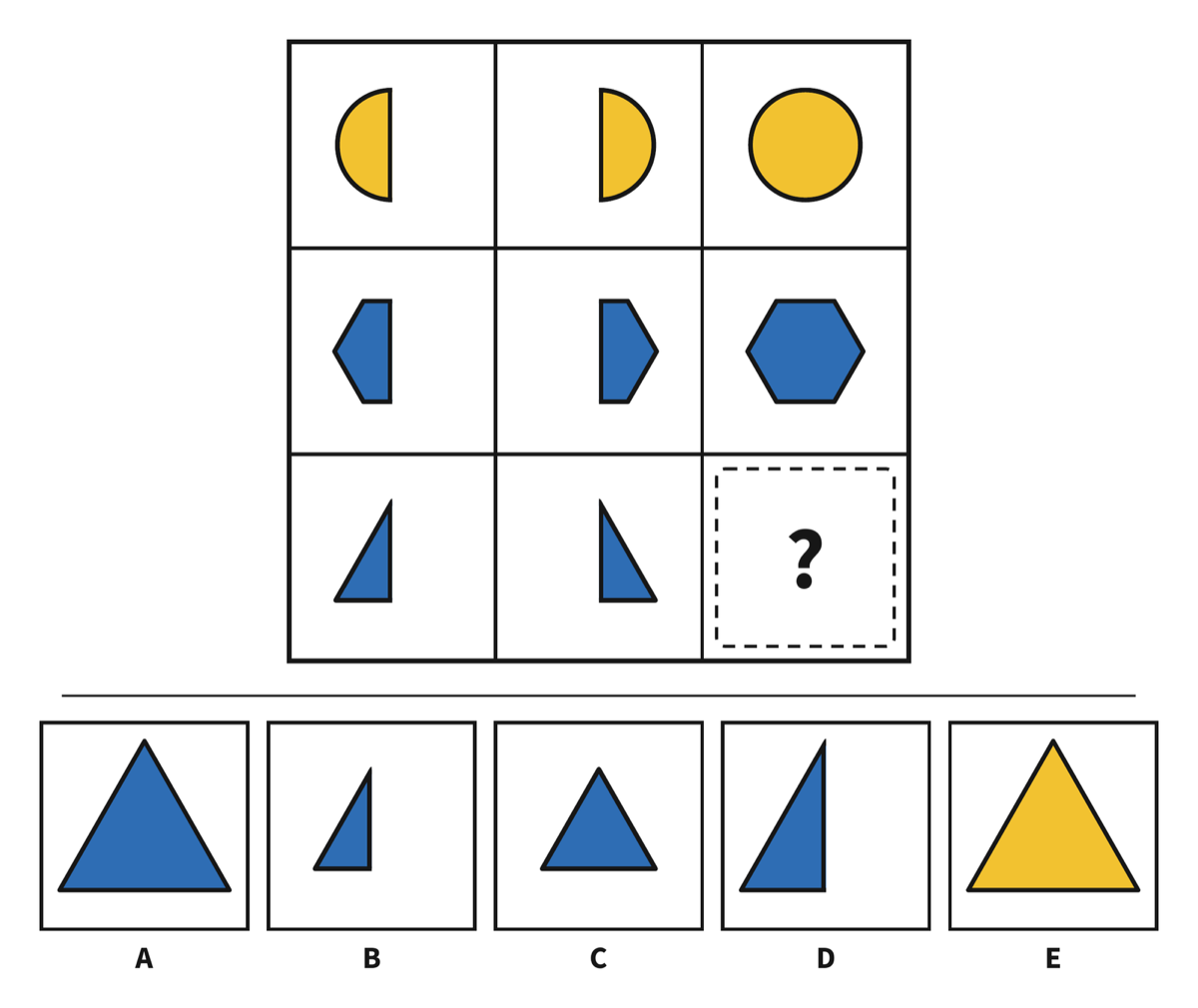
Question 3
See the answer and rule
Answer C. This kind of puzzle is called “Joining two halves” in the workbook.
In each row, the first two pictures are two halves of one shape. Slide them together and they make the whole shape in the third box, with each half keeping its color. Join the two halves in the bottom row. The missing picture is a blue triangle: choice C. Choice A has the right shape and colors but is too big. Choice B shows only one half. Choice D has only one half of the shape and the wrong size (too big). Choice E has the wrong size (too big) and the wrong color (yellow).
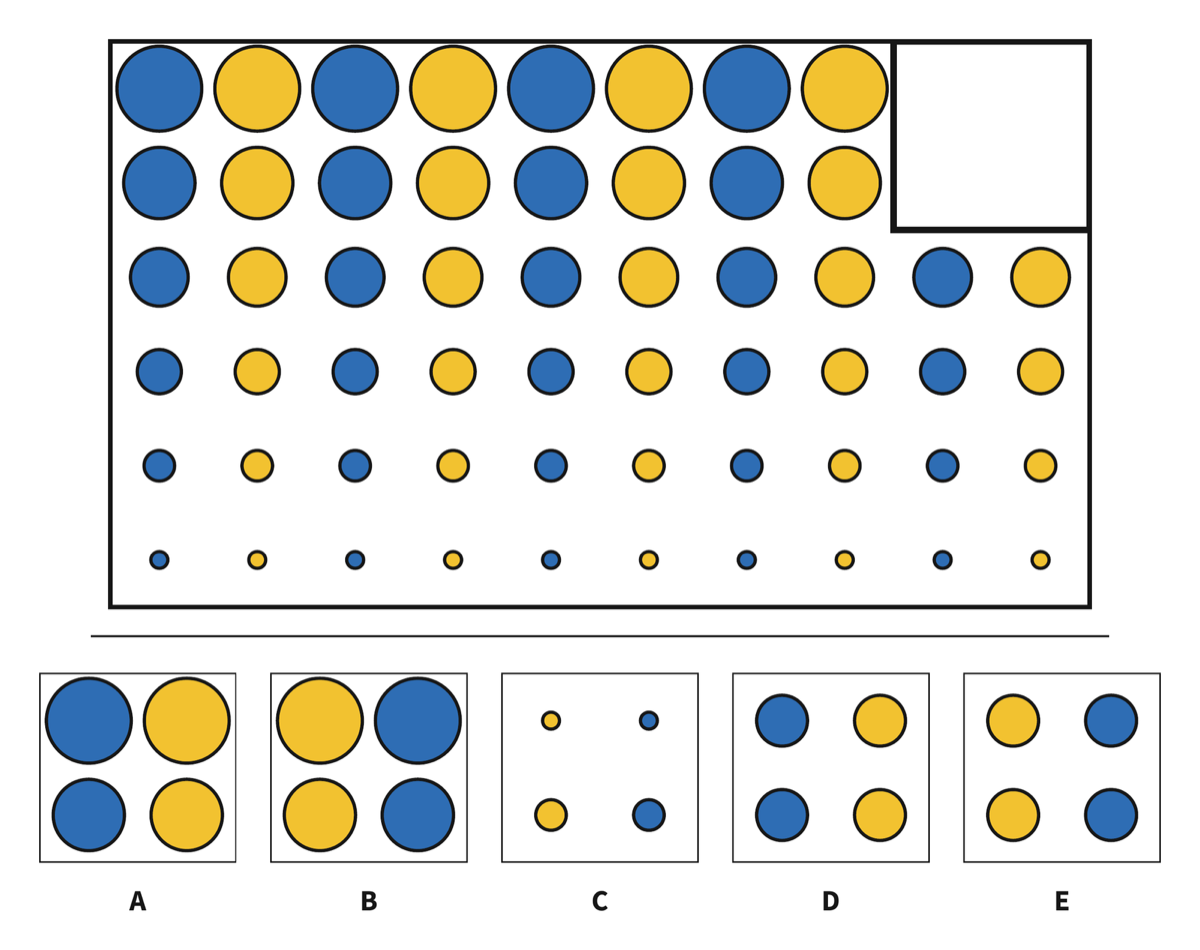
Question 4
See the answer and rule
Answer A. This kind of puzzle is called “Shapes that grow” in the workbook.
Going from bottom to top, the dots get a little bigger at every step. Each column keeps its own color. Pick the patch whose dots are the right sizes for the part of the picture the white box covers, with the right color in each column. Choice A is the only patch that matches. Choice B puts the colors in the wrong columns. Choice C puts the colors in the wrong columns and also has dots that shrink instead of grow. Choice D makes all the dots the same size. Choice E makes the dots all the same size and puts the colors in the wrong columns.
Question 5
See the answer and rule
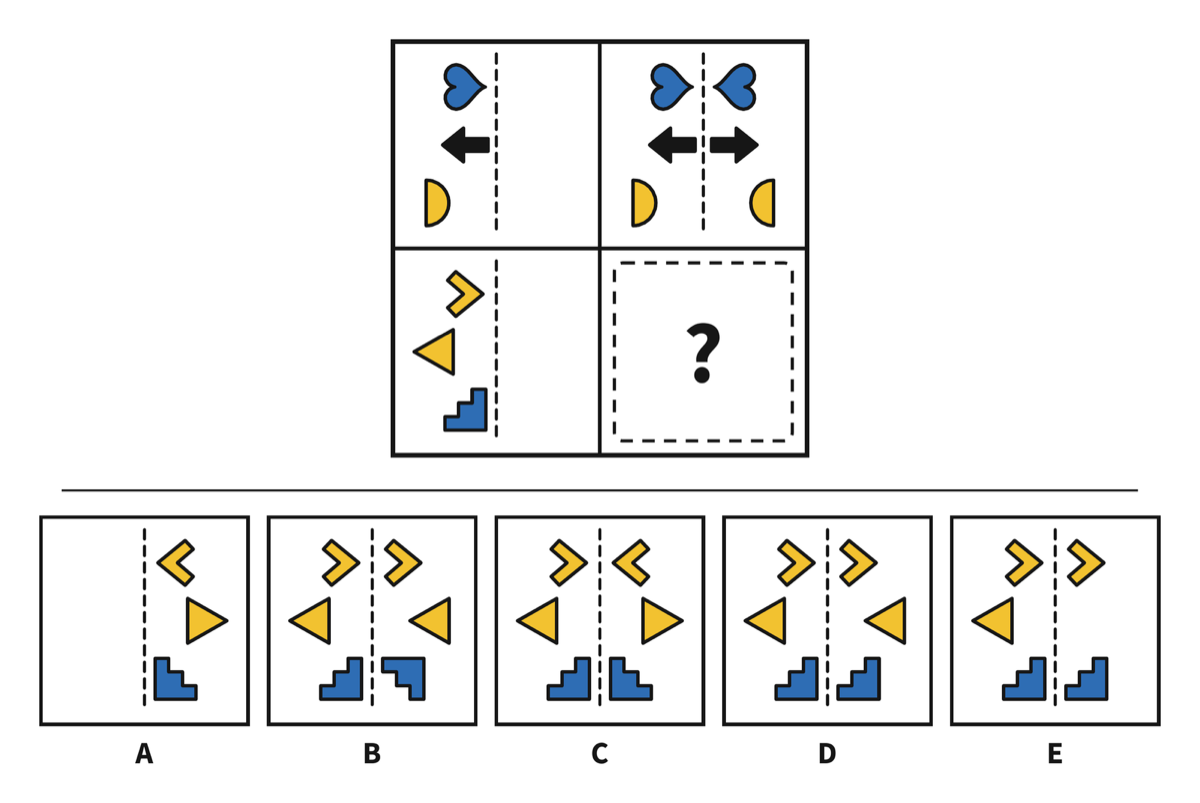
Answer C. This kind of puzzle is called “Folding over” in the workbook.
The dashed line is a fold. In the top row, fold the paper along the dashed line and press: every shape is printed on the other side as a mirror image, in the matching spot. Do the same with the bottom-left picture: each shape appears again on the other side of the line, flipped left to right. The missing picture is the shapes on both sides of the fold line, each one a mirror image of its partner: choice C. Choice A shows only the folded copies and leaves out the shapes that were already there. Choice B puts each copy in the right spot but flips it upside down instead of left to right. Choice D slides the shapes across without flipping them like a mirror. Choice E slides the shapes across without flipping them, and forgets one.
Question 6
See the answer and rule
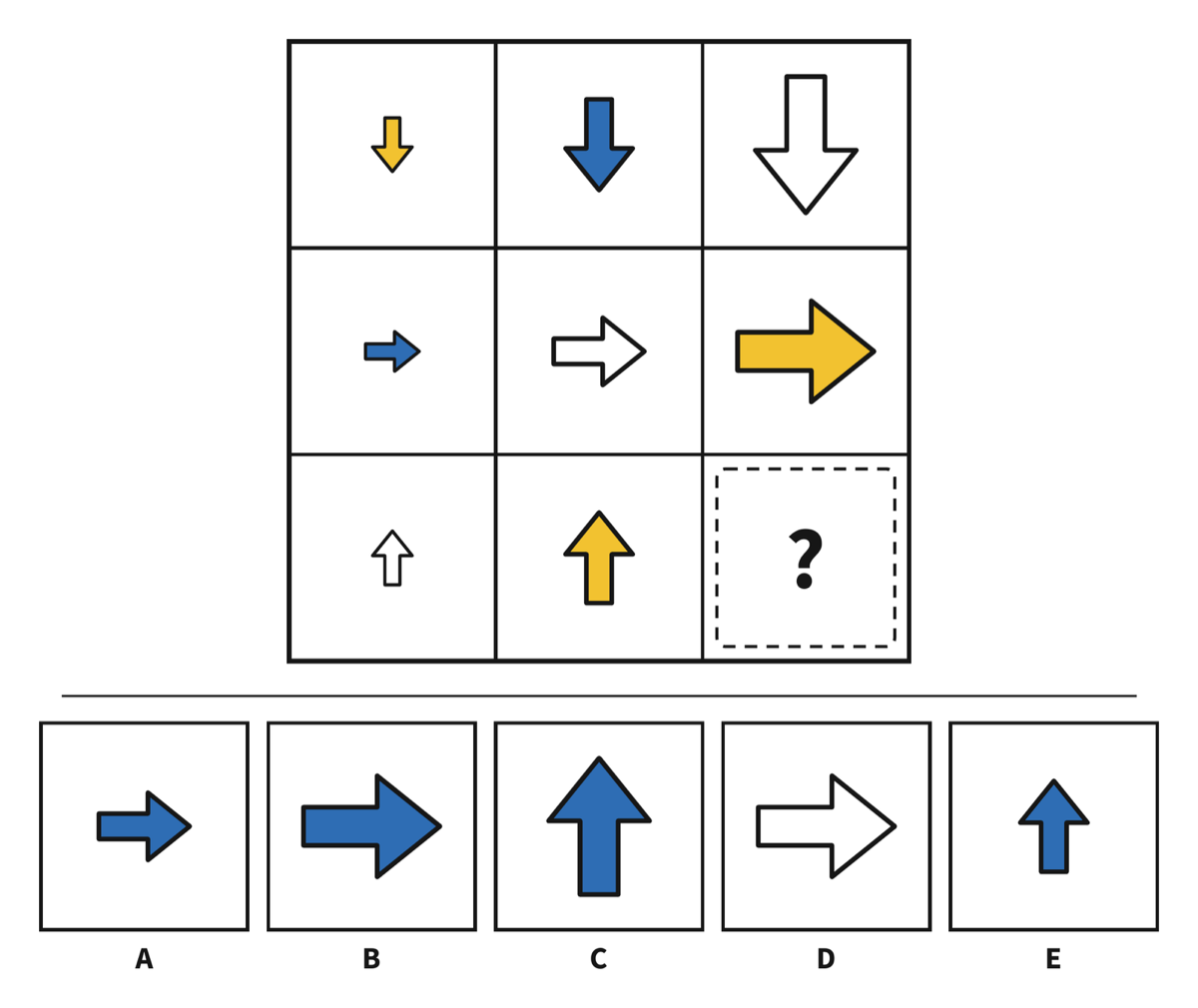
Answer C. This kind of puzzle is called “Changes going across and going down” in the workbook.
Two things change in two directions. Going down each column, the arrows turn a quarter turn to the left. Going across each row, the arrow gets bigger each time. The colors also follow their own rule: every row and every column has each color once. Use the bottom row to decide how big it is, and the last column to decide which way it points. The missing picture is a big blue arrow pointing up: choice C. Choice A is the wrong size and does not turn. Choice B forgets to turn. Choice D has the wrong direction and the wrong color (white). Choice E is the middle size instead of the biggest.
Print the six questions.
Six questions · 7 pages · 1.1 MB · Explained answers
Text version (screen-reader friendly): NNAT3 Level D workbook sample
Try the 16-question Level D practice test or print the color PDF →
What the scores mean.
The headline number is the Naglieri Ability Index (NAI). It runs from 40 to 160, with 100 as the average for children of the same age. Pearson’s manual says about 68% of students score between 84 and 116, and about 95% between 68 and 132.
Reports can also show a percentile rank and a stanine. A percentile rank of 90 means the child scored as well as or better than 90% of the comparison group; it is not the share of questions answered correctly.
The cutoff for a gifted program is the district’s decision, and most districts weigh the test alongside other evidence. Some compare children with a local group instead of the national one. Our guide to gifted-test scores explains percentiles, stanines and local norms in more detail.
NNAT vs. NGAT.
NNAT3
Naglieri Nonverbal Ability Test, Third Edition. One nonverbal test. Published by Pearson. Levels A to G.
NGAT
Naglieri General Ability Tests. Three separate tests: Verbal, Nonverbal and Quantitative. Published by MHS.
Districts do switch between them. Fairfax County, for example, gave the NNAT3 to every first grader before it adopted the NGAT in 2025–26. If your notice says NGAT, start with our NGAT guide. To see all four common tests side by side, use the test comparison.
NNAT districts in our tracker.
These district guides name the NNAT, and each lists its official sources.
- Prince William County (VA)NNAT3 for every second grader, with online sessions also listed for Grades 6 and 9.
- Arlington (VA)NNAT in Grade 1 as part of universal screening.
- Falls Church City (VA)NNAT3 for every first grader.
- Alexandria City (VA)NNAT as part of universal screening.
All four test in Grade 1 or Grade 2. The NNAT3 is used well beyond these four, and Level D exists for Grades 3 and 4, but we list only districts whose sources we have checked. The notice from your child’s school is the source for the grade, the date and the level.
If you decide to practice.
The test itself begins with sample questions, so no child meets the format cold. Some districts ask families not to prepare; follow your school’s advice.
If your child enjoys puzzles and you want to try a few, these habits keep it useful:
- Say the rule aloud. “The stripes keep going” or “it gets bigger” is the skill. A right answer without a rule is a guess.
- Check every choice. Wrong answers are usually right about one thing and wrong about another.
- Stop early. Ten minutes and a handful of puzzles is plenty for one sitting.
No practice material can predict an NAI or a placement decision.
Questions parents ask about the NNAT
Is the NNAT the same test as the NGAT?
No. The NNAT3 is one nonverbal test published by Pearson. The NGAT (Naglieri General Ability Tests) is a set of three tests, Verbal, Nonverbal and Quantitative, published by MHS. Both carry the Naglieri name, so check the full name on the school’s notice.
Which NNAT3 level will my child take?
Level A is for kindergarten, Level B for Grade 1, Level C for Grade 2 and Level D for Grades 3 and 4. Separate levels cover Grades 5 to 12. The school chooses the level; it normally follows the child’s grade.
How long is the NNAT3?
Each form has 48 questions. Students have 30 minutes to work once the sample questions are done, and Pearson’s manual puts the whole session, with directions, at about 35 to 45 minutes.
Does my child need to read or do arithmetic?
No. The questions are abstract designs, and the teacher reads the directions aloud. Children answer by choosing the piece or picture that completes the design.
What is a good NNAT score?
The main score is the Naglieri Ability Index, on which 100 is average for the child’s age. What counts as high enough is set by each district, and most districts look at more than one piece of evidence. Ask the school which score and cutoff it uses.
Should my child practice?
That is a family decision, and some districts discourage it. If you do practice, the useful part is getting used to how the puzzles work and explaining the rule aloud. No practice material can predict or guarantee a score.
Sources and scope
Publisher pages checked November 11, 2026. Test facts on this page come from Pearson’s own manual, product page and FAQ. School plans change, and your school’s current notice is the source for your child’s arrangements.
- Pearson: NNAT3 Levels A–D manual (PDF)
- Pearson: NNAT3 product page
- Pearson: NNAT3 frequently asked questions (PDF)
- Pearson: NNAT3 lower levels, 2018 updated norms (PDF)
NNAT® is a registered trademark of NCS Pearson, Inc., used here for identification purposes only. Reasonwell Press is independent and is not affiliated with, endorsed by, sponsored by, or licensed by NCS Pearson, Inc., which was not involved in producing our materials. Our practice materials are original NNAT®-style items, not actual test questions, and do not guarantee any score or placement outcome.